Dealing With A USAA Auto Accident Claim


Every article on this site is researched by our internal team, reviewed for legal accuracy against current Texas law, and held to State Bar of Texas advertising standards before publication. We do not publish content that overstates outcomes or makes promises about results.
Learn more about our
editorial standards .
Key Takeaways
- USAA only insures military families, but Texas insurance laws still govern every claim it handles.
- Third-party claimants face a tougher process than USAA members filing under their own policy.
- Texas law gives you 15-day acknowledgment rights and bad faith remedies against unfair denials.
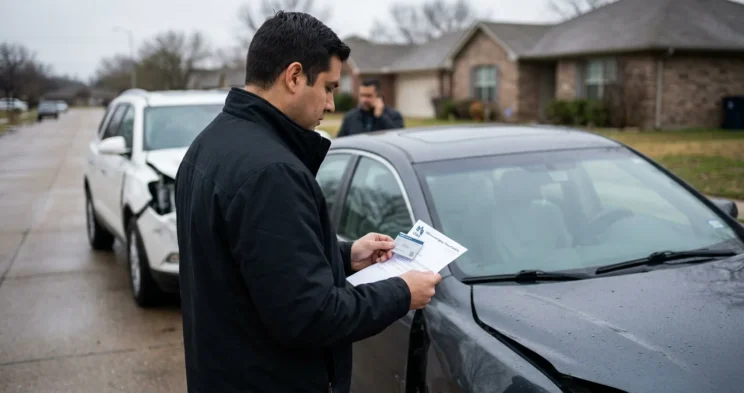
You’re driving home through Fort Worth when another car runs a red light and slams into your side. The other driver hands you an insurance card with a USAA logo, and you’ve never dealt with that company before. Now you’re staring at a claim number, a damaged vehicle, and questions about whether this insurer plays by the same rules as the rest. The answers depend on whether you’re a USAA member or filing against one.
Understanding USAA’s Military-Exclusive Status
USAA only sells insurance to active military, veterans, and their immediate family members. That eligibility rule shapes who you’ll meet on the other end of the phone, but it does not change the laws USAA must follow in Texas.
Membership at USAA requires a documented military service connection. Spouses, children, and widowed family members of qualifying service members can also join. If you’re not part of that group, you cannot buy a USAA policy. You can still file a claim against a USAA-insured driver who hit you.
USAA earns strong customer satisfaction scores year after year, receiving a score of 900 in the 2023 J.D. Power Auto Claims Satisfaction Study. Those scores reflect how USAA treats its own members. Non-members filing third-party claims do not always get the same experience. The firm’s background in handling these disputes is covered on our about us page.
USAA must follow every Texas insurance regulation, regardless of who it insures. That includes Texas Insurance Code Chapter 541, which prohibits unfair settlement practices. Military exclusivity affects who USAA insures. It does not exempt USAA from state oversight.
USAA Policyholder vs. Third-Party Claims
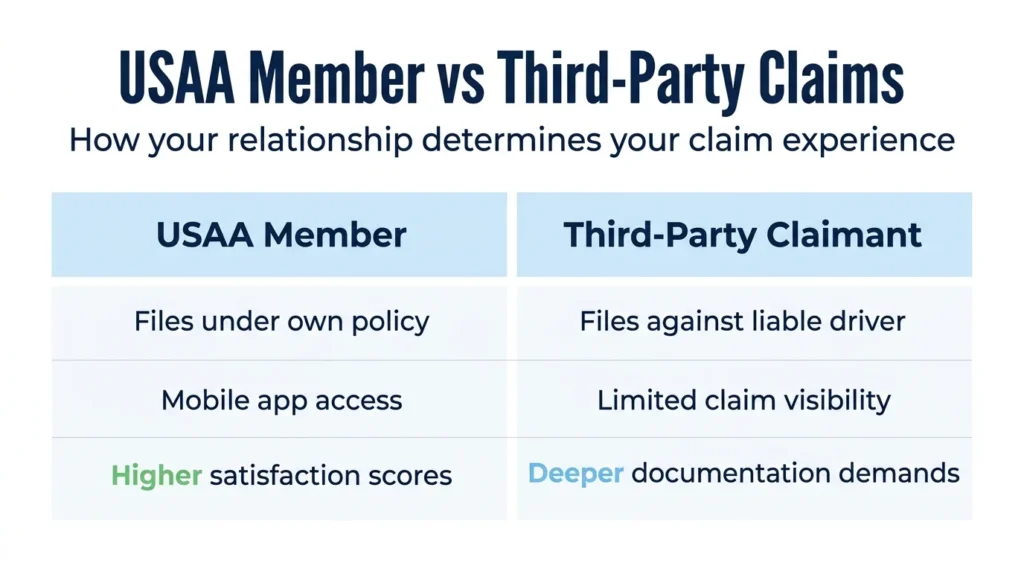
Your role in the accident decides which path you take. USAA members file a first-party claim under their own policy. Non-members file a third-party claim against the at-fault USAA driver.
Filing Your Own Claim as a USAA Policyholder
If you’re a USAA member, you report the accident through the mobile app, the website, or a phone call. USAA assigns an adjuster, opens a claim number, and starts coverage analysis. Members often praise the speed and digital tools. Following the right early steps still matters, and our guide on what to do after a car accident in Texas walks through them.
Third-Party Claims Against USAA-Insured Drivers
If a USAA driver hit you and you don’t have a USAA policy, your claim runs through their liability coverage. You call USAA, give them the basic facts, and wait for an adjuster assignment. The adjuster works for USAA, not for you. Their goal is to protect their insured and limit payout amounts.
Documentation Requirements
Both claim types need similar paperwork: the police report, photos, medical records, repair estimates, and witness contact information. Third-party claimants often face deeper documentation requests because USAA wants to confirm liability before paying. Our legal team can provide help and guidance on dealing with insurance companies after an accident. We’ll explain how to organize records before sharing them.
USAA Claims Process in Texas
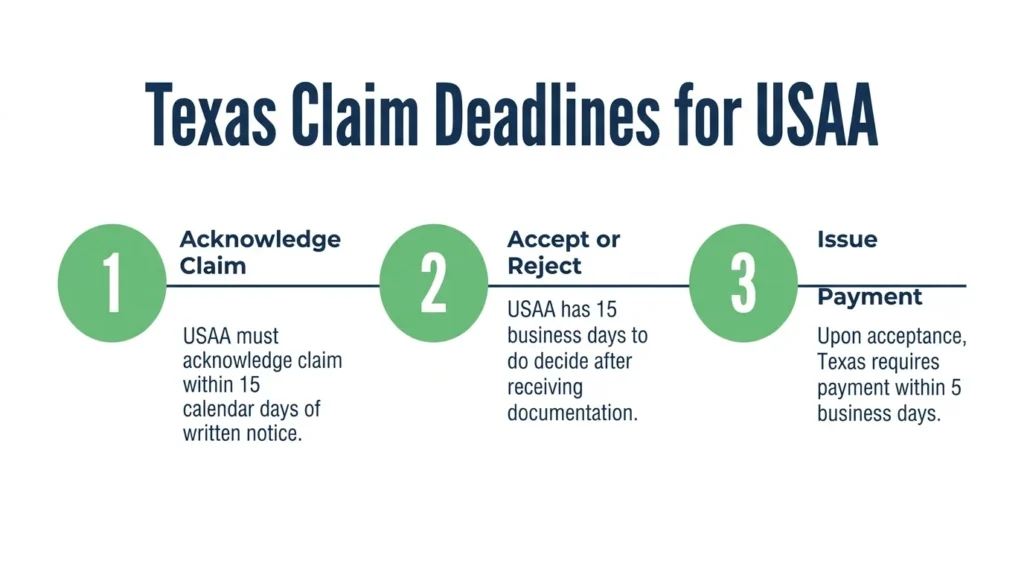
USAA must acknowledge a Texas claim within 15 days and accept or reject it within 15 business days after receiving all requested information. Those deadlines come from Texas Insurance Code Chapter 542, known as the prompt payment statute.
After you report the accident, USAA opens an investigation. The adjuster reviews the police report, interviews involved parties, and inspects vehicle damage. For injury claims, they request medical records and bills. Serious injury cases stretch longer because the adjuster waits for treatment to finish before valuing the claim.
Evidence gathering on your end should not stop with the police report. Save every medical bill, prescription receipt, and pay stub showing lost wages. Photograph injuries as they heal. Keep a written log of pain levels and missed activities.
The settlement phase begins after USAA finishes its valuation. The first offer is rarely the best one. Adjusters often start low to see if you’ll accept quick cash. If your injuries are serious and the offer feels off, that’s a signal to get a second opinion before signing anything.
When USAA Disputes Your Claim
USAA disputes claims for predictable reasons: questions about liability, gaps in medical treatment, pre-existing conditions, or disagreements over injury severity. Knowing the playbook helps you respond.
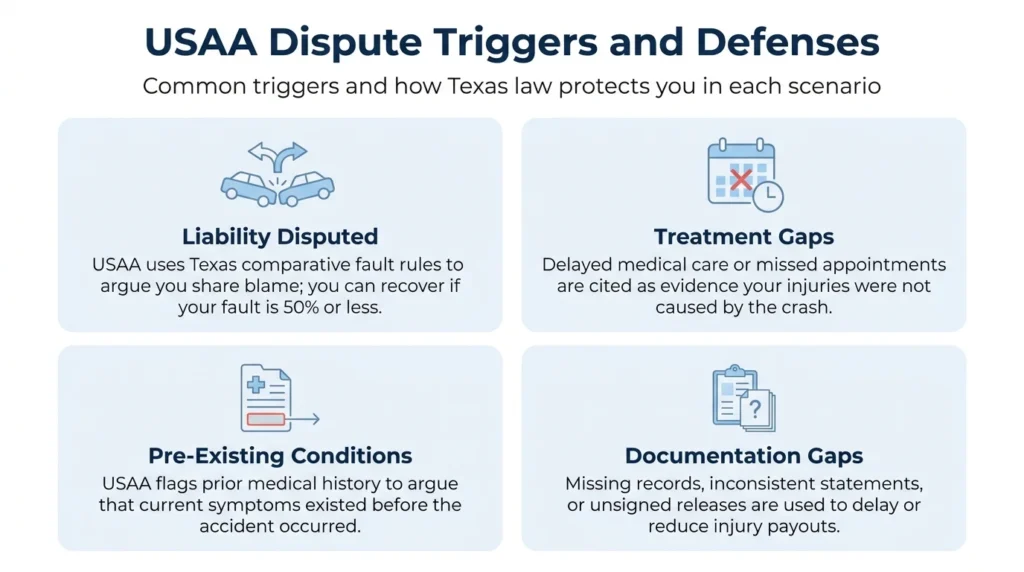
Common dispute triggers include delayed medical care, missing documentation, inconsistent statements, and high-value injury claims. USAA may also argue comparative fault, claiming you share blame for the crash. Texas allows you to recover damages as long as your fault is 50 percent or less. If USAA’s behavior crosses into unfair handling, the [Texas Department of Insurance complaint process](https://www.tdi.texas.gov/consumer/complaints/index.html) gives you a formal channel.
Texas law penalizes insurers that act in bad faith. Texas Civil Practice and Remedies Code Chapter 38 allows attorney’s fees in certain insurance cases, and Chapter 541 lets policyholders recover extra damages for unfair practices. Our legal team can explain how these claims work against carriers like USAA.
If you face a denial or a lowball offer, do not accept the offer or sign a release. Request a written explanation of the denial. Gather any missing documents the adjuster cited. Then talk to an attorney about your options.
Get an Attorney Experienced with USAA
Angel Reyes & Associates has spent more than 30 years going up against major insurers, including USAA, on behalf of injured Texans. With more than $1 billion recovered for clients, we have built a reputation as a strong, effective, and valuable ally for those who need assistance standing up to the machine of a large insurance company.
We handle car accident claims on a contingency basis, meaning you pay no legal fees unless we win your case. If a USAA claim is stalling or the offer doesn’t match your injuries, contact us for a free case review today.
Past results do not guarantee future success.
USAA Auto Accident Claim FAQs
Can I get USAA insurance if my spouse is a veteran but I'm not military?
Yes, spouses of qualifying military members can obtain USAA insurance coverage. Children and widowed spouses of eligible service members also qualify for membership.
What happens if USAA totals my car but I still owe money on the loan?
USAA pays the actual cash value of your vehicle, which may be less than your loan balance. Gap insurance through USAA or your lender can cover the difference between the settlement and what you owe.
Does USAA have to pay for a rental car while mine is being repaired?
USAA must provide rental coverage if the at-fault driver carried rental reimbursement on their policy. As a third-party claimant, you’re entitled to reasonable transportation costs during repairs.
Can USAA access my medical records from before the accident?
USAA can request prior medical records to investigate pre-existing conditions, but you have the right to limit access to relevant records. They cannot demand unrelated medical information without your consent.
What if the USAA driver who hit me doesn't have enough insurance to cover my damages?
You can pursue the at-fault driver personally for amounts exceeding their policy limits. Your own uninsured/underinsured motorist coverage may also apply if you carry that protection.
About the Authors

Angel Reyes
Writer
Angel L. Reyes, III is the Founder and Managing Partner of Angel Reyes & Associates. A nationally recognized trial attorney and business leader, Angel has helped over 70,000 injury victims recover more than $1 billion since founding the firm in 1993. Named to the Texas Super Lawyers list annually since 2008, Angel brings Wall Street experience, Ivy League education, and a deep commitment to client advocacy. He is a frequent legal commentator and published author with extensive contributions to legal scholarship, trial strategy, and consumer protection.

Kyle Nicolas
Editor
Kyle Nicolas is the Web Content & SEO Manager at Angel Reyes & Associates. He has more than 10 years of experience as a marketing co...

Spencer Browne
Reviewer
Spencer Browne is a partner at Angel Reyes & Associates and a Board Certified personal injury trial lawyer with nearly 100 jury trials a...