


What to Do Immediately After a Hit-and-Run in Texas
Your heart pounds as you watch taillights disappear into the distance.
The driver who just crashed into you is gone, leaving you injured, confused, and alone on a Texas roadway.
In this moment of shock and anger, your next actions determine whether you’ll receive fair compensation or become another victim lost in the system.
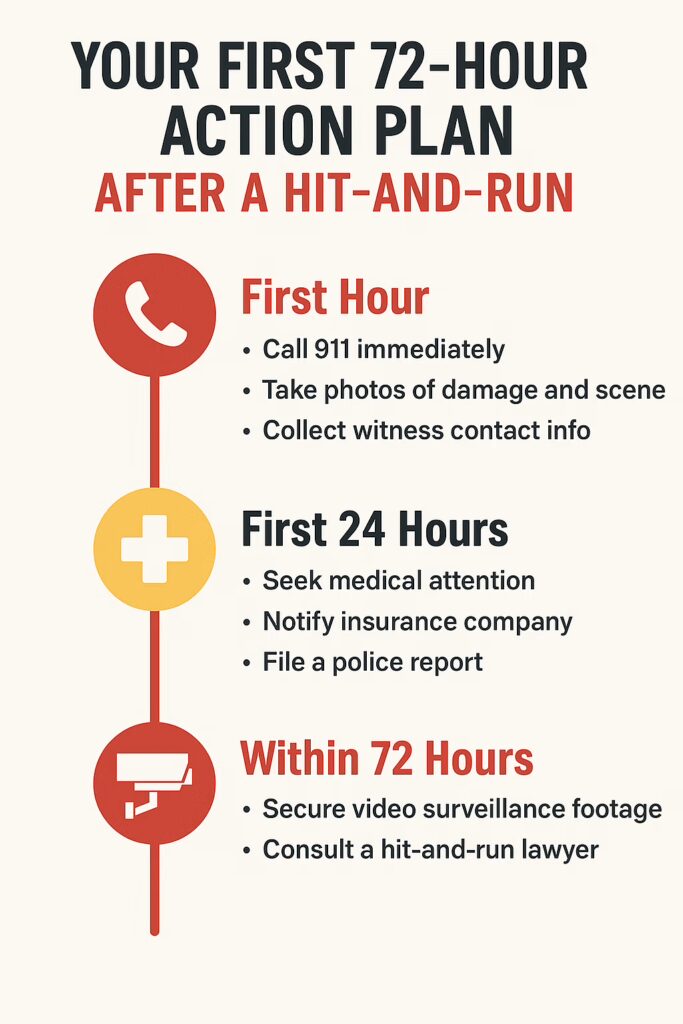
Call 911 Immediately
Report the hit-and-run to law enforcement and request medical responders if injuries exist. Tell the dispatcher you need officers to document a hit-and-run accident.
This creates an official record crucial for both criminal prosecution and your insurance claim. Request the police report number before officers leave.
You’ll need it within hours.
Gather Any Available Evidence Before It Vanishes
Use your phone to photograph everything: vehicle damage from multiple angles, debris on the road, skid marks showing the impact point, paint transfer on your vehicle, and your visible injuries.
If you spot security cameras on nearby buildings or homes, note their locations.
Dashcam footage often captures fleeing vehicles or at least their direction of travel.
Look for license plate fragments, broken mirror pieces, or any parts left behind. Forensic analysis can identify vehicle makes and models from surprisingly small pieces.
Talk to Witnesses Immediately
People scatter quickly after accidents. Approach anyone who saw the crash and get their names, phone numbers, and a brief statement about what they witnessed.
Record voice memos on your phone while memories remain fresh. Even partial descriptions help.
“Dark SUV heading north” or “pickup truck with ladder racks” gives investigators starting points.
Seek Medical Attention Within Hours, Not Days
Adrenaline masks serious injuries. Internal bleeding, concussions, and spinal damage often show no immediate symptoms.
Visit an emergency room or urgent care facility immediately, even if you “feel fine.” Document every symptom with healthcare providers.
This medical record becomes critical evidence linking your injuries to the hit-and-run.
Notify Your Insurance Company Today
Most policies require immediate reporting of accidents, especially hit-and-runs.
Call your insurer but stick to facts: date, time, location, and that the other driver fled. Avoid speculating about fault or downplaying injuries.
Keep detailed notes of all insurance communications including claim numbers, adjuster names, and conversation summaries.
File a Formal Police Report if Officers Didn’t Come to the Scene
Texas law requires accident reports for property damage over $1,000 or any injury. Visit the nearest police station to file this report within 24 hours.
Most insurers won’t process uninsured motorist claims without proof you reported the hit-and-run to law enforcement.
Why the First 72 Hours Are Critical
Evidence has an expiration date in hit-and-run cases. Surveillance footage from nearby businesses gets overwritten every 24-72 hours as systems record new content.
That crucial video showing the fleeing vehicle’s license plate disappears forever once deleted. Business owners rarely save footage without immediate requests.
Witness memories fade dramatically after 72 hours.
Studies show eyewitness accuracy drops 50% within three days as people forget details or merge memories with other events.
Witnesses also become harder to locate. They return to normal routines, making follow-up contact difficult or impossible.
Medical documentation grows weaker with delays. Insurance companies argue that injuries appearing days after accidents stem from other causes.
Immediate medical attention creates an unbreakable timeline linking your injuries to the hit-and-run. Gaps in treatment give insurers ammunition to deny or reduce claims.
Insurance deadlines begin immediately. Many Texas insurers require hit-and-run notification within 24-48 hours for uninsured motorist coverage to apply.
Missing these windows can forfeit your right to compensation entirely. Each carrier sets different deadlines buried in policy fine print. Don’t assume you have weeks to report.
Texas Hit-and-Run Laws: What the Law Says About Fleeing Drivers
Understanding Texas law empowers you to fight back against hit-and-run drivers who think they can escape consequences.
Legal Definition & Duties Under Texas Law
Texas Transportation Code §550.021 defines clear duties for all drivers involved in accidents. Every driver must stop immediately at the scene or as close as safely possible.
They must remain at the scene to provide their name, address, vehicle registration number, and insurance information to other involved parties.
If anyone appears injured, drivers must render reasonable assistance, including calling 911 or transporting victims to medical facilities if needed.
Leaving an accident scene violates Texas criminal law regardless of fault. Even if the fleeing driver didn’t cause the crash, departure itself constitutes a crime.
This legal framework exists because hit-and-run crashes prevent proper investigation, deny victims immediate help, and obstruct justice.
Texas takes these violations seriously, with penalties escalating based on damage severity.
The law recognizes no excuses for fleeing. Fear of arrest, lack of insurance, suspended licenses, or immigration concerns don’t justify leaving accident scenes.
Courts consistently reject these defenses, viewing flight as consciousness of guilt that compounds original violations.
Criminal Penalties for Leaving the Scene in Texas
Texas assigns harsh penalties to hit-and-run drivers, treating flight as evidence of criminal intent. These consequences create powerful leverage for your civil injury case.
Fatal hit-and-run accidents constitute second-degree felonies in Texas. Convicted drivers face 2 to 20 years in state prison plus potential $10,000 fines.
These charges apply even if the fleeing driver didn’t cause the death. Leaving someone to die violates fundamental legal and moral obligations.
Accidents causing serious bodily injury trigger third-degree felony charges. Serious bodily injury includes broken bones, permanent disfigurement, or injuries creating substantial risk of death.
Penalties range from 2 to 10 years imprisonment and up to $10,000 in fines. Prosecutors pursue these charges aggressively, especially when victims suffer life-altering injuries.
Property damage hit-and-runs remain criminal despite no injuries. Damage exceeding $200 constitutes a Class B misdemeanor punishable by up to 180 days in jail and $2,000 fines.
Damage under $200 drops to Class C misdemeanor level but still creates criminal records. Multiple prior offenses can elevate misdemeanors to felony charges.
How Criminal Charges Impact Your Civil Case
Criminal prosecutions create tremendous advantages for civil injury claims. When prosecutors file felony hit-and-run charges, they essentially prove the fleeing driver’s liability for you.
Criminal convictions become powerful evidence in civil court that judges rarely allow defendants to dispute.
Punitive damages become available in hit-and-run cases due to the malicious nature of fleeing. While standard accidents involve negligence, hit-and-runs demonstrate conscious disregard for victim welfare.
Texas juries often award substantial punitive damages to punish this egregious behavior and deter others from fleeing accident scenes.
Criminal investigations uncover evidence that strengthens civil cases. Prosecutors subpoena cell phone records, surveillance footage, and witness statements using powers private attorneys lack.
This evidence becomes available for your civil case, providing proof that might otherwise remain hidden. Even unsuccessful prosecutions generate valuable depositions and documentation supporting your injury claim.
Can You Still Be Compensated if the Driver Isn’t Found?
The crushing realization that the person who hurt you vanished doesn’t mean you’re left without options. Texas law provides multiple compensation paths even when hit-and-run drivers escape identification.
Your own auto insurance becomes your primary protection through Uninsured Motorist (UM) coverage.
This coverage, which Texas insurers must offer and you must specifically decline in writing, pays for injuries caused by hit-and-run drivers just as if they carried no insurance.
Most Texas drivers carry UM coverage without realizing it protects against hit-and-runs until they desperately need it.
UM coverage typically pays for medical expenses from emergency treatment through complete recovery, lost wages during treatment and recovery periods, vehicle repairs or fair market value if totaled, rental car costs while your vehicle undergoes repairs, and pain and suffering compensation within policy limits.
These benefits apply regardless of whether police ever identify the fleeing driver.
Time sensitivity cannot be overstated for UM claims. While Texas law provides general claim deadlines, individual insurance policies often impose much stricter requirements.
Some insurers demand hit-and-run notification within 24 hours. Others allow 72 hours but require specific documentation.
Missing these windows can void coverage entirely, leaving you with no recourse. This creates an urgent need to act immediately after any hit-and-run accident.
Understanding UM/UIM Coverage in Texas
Texas insurance law creates important protections that many drivers don’t understand until accidents occur. Insurance companies must offer UM/UIM coverage equal to your liability limits unless you specifically refuse in writing.
This means if you carry 100/300 liability coverage, you should have matching UM/UIM protection unless you signed rejection forms.
Minimum UM coverage in Texas includes $30,000 per person for bodily injury, $60,000 per accident when multiple people suffer injuries, and $25,000 for property damage.
These minimums often prove inadequate for serious accidents, making higher coverage limits critical protection against hit-and-run drivers.
UM coverage specifically includes hit-and-run accidents under Texas Insurance Code provisions.
The coverage applies when drivers flee without providing required information, phantom vehicles force you off the road without contact, or identified drivers lack any insurance coverage.
Physical contact isn’t always required. If witnesses confirm another vehicle’s actions caused your accident, coverage may still apply.
Common Insurance Company Tactics After Hit-and-Runs
Insurance companies deploy specific strategies to minimize hit-and-run payouts, knowing victims feel vulnerable without identified defendants. Understanding these tactics helps you protect your rights during the claims process.
Demanding proof the phantom driver existed becomes the first hurdle. Adjusters question whether another vehicle was involved or suggest you caused the accident yourself.
They request independent witness statements, physical evidence of impact, or surveillance footage. Evidence that’s often unavailable in hit-and-run cases. Without legal representation, victims struggle to overcome these proof demands.
Delaying investigations until evidence disappears serves insurance company interests. Adjusters move slowly, knowing surveillance footage gets deleted and witnesses become unreachable.
They schedule statements weeks after accidents when memories fade. Each delay weakens your claim while strengthening their position.
Offering quick, lowball settlements exploits victim desperation. Adjusters present immediate cash offers far below claim values, pressuring acceptance before you understand injury severity or repair costs.
They emphasize uncertainty about finding the hit-and-run driver while downplaying your UM coverage rights. These tactics generate massive profits from underpaid claims.
Recorded statement manipulation creates claim-denial ammunition. Adjusters ask leading questions designed to elicit responses that damage claims.
They inquire about speed estimates, distance judgments, and reaction timing. Technical details victims can’t accurately provide. Later, they cite inconsistencies or admissions from these statements to reduce or deny coverage.
How a Texas Hit-and-Run Lawyer Helps You Take Control
Our investigators work fast to preserve security footage, interview witnesses, and analyze evidence like paint transfers and debris patterns that reveal vehicle details.
Insurance companies often deny or lowball hit-and-run claims. We know exactly which policy provisions apply and how to document your injuries properly.
Our representation typically triples settlement offers because we back negotiations with litigation threats that get immediate attention.
If the driver is never found, we maximize your uninsured motorist coverage and explore every compensation source available.
You focus on recovery while we handle the investigation, insurance battles, and legal complexity.
Why Local Experience in Texas Law Matters
Texas hit-and-run cases require local expertise. We know which police departments actually solve these cases and which judges allow criminal evidence in civil trials.
This knowledge directly impacts your compensation.
Each Texas county operates differently. Some jurisdictions prioritize hit-and-run victims while others create months of delays. We navigate these systems daily, avoiding procedural mistakes that kill cases for out-of-state firms.
Insurance companies also play regional games. They offer less in counties known for conservative juries and settle faster in plaintiff-friendly venues.
We know their playbook and use it against them to maximize your settlement.
How Long Do You Have to Report and File a Hit-and-Run Claim in Texas?
Time limits create urgent deadlines that many hit-and-run victims miss, forfeiting valuable rights through delay.
Police reporting should occur immediately but absolutely within 24 hours. Texas Transportation Code requires accident reports for significant property damage or any injury.
Delayed reporting raises questions about accident severity and circumstances. Insurance companies cite reporting delays as evidence claims lack merit.
Some policies specifically require police reports within impossibly short timeframes. As little as 24 hours for UM coverage activation.
Insurance claim notification varies dramatically between carriers but trends toward shorter deadlines. Progressive might require 72-hour notice while State Farm allows 30 days.
Policy language controls these deadlines, not general assumptions. Missing insurer deadlines can void coverage entirely, regardless of injury severity or clear liability.
This creates an immediate need to review your specific policy requirements.
Medical treatment timing affects claim viability beyond formal deadlines. Insurance companies argue that treatment delays indicate either minor injuries or alternative causation.
Emergency room visits within hours of accidents establish clear timelines. Waiting weeks before seeking treatment invites claim disputes that reduce compensation.
Consistent follow-up care documents ongoing injury impacts supporting larger settlements.
Lawsuit filing deadlines provide final backstops against total claim loss. Texas’s two-year statute of limitations for personal injury applies to hit-and-run cases from accident dates.
This seems lengthy but disappears quickly during treatment and failed insurance negotiations. Identified hit-and-run drivers might invoke shorter government claim deadlines if employed by public entities.
Legal consultation ensures no deadline passes unnoticed.
FAQs About Hit-and-Run Accidents in Texas
What should I do immediately after a hit-and-run in Texas?
Call 911 to report the accident and request medical assistance if needed. Document everything possible at the scene including photos of damage, witness information, and any debris from the fleeing vehicle.
Seek medical attention even if injuries seem minor. Adrenaline often masks serious conditions.
Report the accident to your insurance company within 24 hours and request your policy’s specific hit-and-run claim requirements.
File a formal police report if officers didn’t respond to the scene. Contact an attorney immediately to preserve evidence before it disappears.
What are the penalties for leaving the scene in Texas?
Texas assigns criminal penalties based on accident severity. Fatal hit-and-runs constitute second-degree felonies punishable by 2-20 years in prison.
Serious injury accidents become third-degree felonies carrying 2-10 years imprisonment. Property damage exceeding $200 creates Class B misdemeanor charges with potential 180-day jail sentences.
Even minor property damage generates Class C misdemeanor records. These criminal charges strengthen civil injury claims by establishing the fleeing driver’s consciousness of guilt and disregard for victim welfare.
Will insurance pay if the driver isn’t found?
Yes, if you carry Uninsured Motorist (UM) coverage, which most Texas drivers have unless specifically rejected in writing.
UM coverage treats hit-and-run accidents like uninsured driver crashes, paying for medical expenses, lost wages, property damage, and pain and suffering within policy limits.
Coverage applies regardless of whether police identify the fleeing driver. However, strict notification deadlines apply.
Some insurers require claims within 24-72 hours of accidents. Missing these deadlines can void coverage entirely.
Do I need a lawyer if the driver is never caught?
Legal representation becomes even more critical when hit-and-run drivers escape identification.
Insurance companies exploit the absence of defendants by challenging whether accidents occurred as claimed, demanding extensive proof that’s difficult to obtain alone.
Attorneys preserve disappearing evidence, counter insurance delay tactics, and document injuries properly for maximum compensation.
Experienced lawyers know how to navigate UM coverage requirements and overcome insurance company resistance. They also monitor law enforcement investigations and can pursue claims if drivers get identified later.
How long do I have to report a hit-and-run accident?
Report to police immediately or within 24 hours maximum for best results. Insurance notification deadlines vary by carrier but often fall within 24-72 hours for UM coverage.
Check your specific policy language. Medical treatment should begin immediately to document injury causation.
Texas’s two-year statute of limitations provides the absolute deadline for filing lawsuits, but waiting reduces evidence quality and claim values. Early action consistently produces better outcomes than delayed response in hit-and-run cases.
Take Action Now Before Your Rights Expire
Every hour after a hit-and-run accident, your case grows weaker. Surveillance footage gets deleted. Witnesses forget details or become unreachable.
Insurance deadlines pass silently, eliminating coverage. The driver who fled continues destroying evidence while you wait.
This isn’t the time for hesitation. It’s the time for decisive action with experienced legal guidance.
At Angel Reyes & Associates, we’ve spent over 30 years fighting for hit-and-run victims across Texas. We understand the unique anger and violation these cowardly acts create.
Our teams launch immediate investigations while evidence remains fresh. We handle insurance companies who try to exploit your vulnerable position.
Most importantly, we ensure hit-and-run drivers don’t escape accountability through our aggressive representation.
The driver who hit you made a choice to flee. Now you must choose whether to fight back or let them win.