



At the Scene: What to Do Immediately After the Crash
The moments after impact determine whether you protect your rights or lose them forever.
Your adrenaline surges, hands shake, and clear thinking becomes nearly impossible. Yet Texas law requires specific actions, and insurance companies count on your mistakes during this chaos.
Knowing what to do after a car accident protects both your safety and your legal rights.
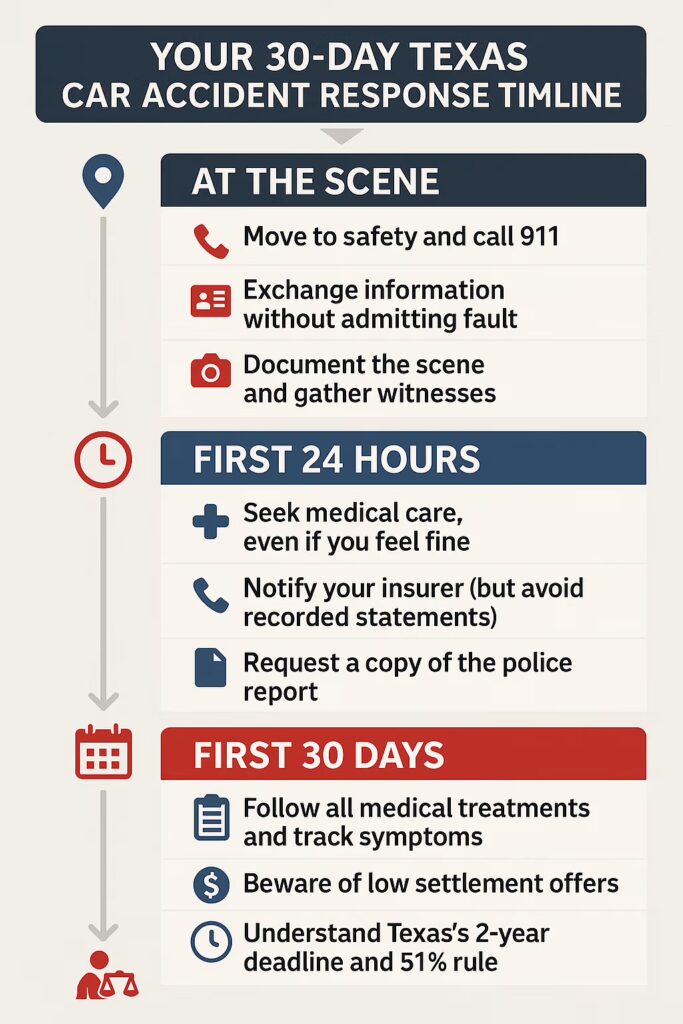
Move to Safety and Call 911
Your first priority is preventing additional harm. If your vehicle can move, Texas law requires clearing the roadway to avoid blocking traffic.
Turn on hazard lights immediately and move to the shoulder or nearest safe area. Exit on the side away from traffic.
Even in minor fender-benders, staying in active traffic lanes creates deadly secondary collision risks.
Call 911 for any accident involving injuries, deaths, or property damage appearing to exceed $1,000. Texas Transportation Code Chapter 550 mandates reporting these accidents immediately.
The dispatcher will determine appropriate emergency response based on your description. Be clear about injuries, traffic hazards, and exact location using cross streets or mile markers.
Police reports become crucial evidence even in seemingly minor accidents.
Officers trained in accident investigation document details you might miss while dealing with shock.
Their reports carry weight with insurance companies and courts. Without official documentation, proving fault becomes your word against theirs, and insurance companies know who usually loses that battle.
Exchange Information With the Other Driver
Texas law requires exchanging specific information with all involved drivers. Get their full name, driver’s license number, vehicle registration, and insurance details.
Photograph these documents rather than just writing information down. Errors in copying could complicate your claim later.
Also document the vehicle’s make, model, color, and license plate number.
Limit conversation to required information exchange. Anything you say can become evidence against you.
Never apologize or admit fault, even saying “I’m sorry” out of politeness.
Don’t discuss how the accident happened, your speed, or what you were doing before impact. Insurance companies twist innocent statements into admissions of guilt.
If the other driver refuses to exchange information, becomes aggressive, or flees the scene, don’t pursue them.
Note their license plate and vehicle description, then let police handle it. Your safety matters more than catching a hit-and-run driver.
Focus on gathering what information you can from witnesses and physical evidence instead.
Document the Scene Thoroughly
Comprehensive documentation at the scene often determines case outcomes months later. Start with wide-angle photos showing the entire accident scene from multiple directions.
Capture vehicle positions before they’re moved, including their relationship to traffic lanes, signs, and signals. These establish crucial facts about how the accident occurred.
Take detailed photos of all vehicle damage from various angles.
Don’t just photograph obvious damage. Document areas that seem fine too, preventing false claims of pre-existing damage later. Photograph skid marks, debris fields, traffic controls, weather conditions, and road hazards.
If poor visibility contributed, capture that through your photos.
Witness information becomes invaluable as memories fade and people become unreachable. Get full names and phone numbers from anyone who saw the accident.
Ask them to briefly describe what they saw while it’s fresh. Record these statements on your phone if witnesses agree.
Independent witnesses without personal connections provide the most credible testimony.
If You’re Unable to Do These Steps
Serious injuries might prevent you from completing these critical tasks yourself. Don’t risk further injury trying to document evidence.
Your health takes priority over evidence gathering. If you’re transported by ambulance, you can’t control scene documentation, but you can still protect your rights.
Ask passengers, bystanders, or even the other driver to help gather information. Most people willingly assist accident victims.
Have them take photos with their phones and text them to you immediately. Get their contact information so your attorney can obtain their evidence later.
Even partial documentation beats having nothing.
Focus on what you can control from your position. Memorize or voice-record details while they’re fresh: the other vehicle’s description, what happened, road conditions, and witness locations.
Emergency responders often gather basic information you can obtain later. Our guide on immediate post-accident steps provides detailed protocols for various injury scenarios.
Remember, gathering the right information from the other driver remains crucial even if you need help doing it.
Within the First 24 Hours: Medical, Legal, and Insurance Notifications
The day after your accident brings critical decisions that impact your health and legal rights. Adrenaline fades, revealing injuries masked by your body’s initial trauma response.
Insurance companies mobilize their machinery to minimize payouts. Your actions during this window often determine whether you recover fair compensation or get steamrolled by the system.
Get a Medical Evaluation – Even Without Obvious Injuries
Seek medical evaluation within 24 hours, regardless of how you feel. Emergency rooms, urgent care centers, or your primary physician can document crash-related injuries.
This creates an essential link between the accident and your injuries that insurance companies can’t dispute later. Delaying medical care gives them ammunition to claim your injuries came from something else.
Common delayed injuries include concussions, whiplash, internal bleeding, and herniated discs.
These serious conditions often show no immediate symptoms. Traumatic brain injuries might manifest as mild headaches before developing into life-altering cognitive problems.
Soft tissue damage feels like minor soreness before becoming chronic pain requiring surgery. Early diagnosis prevents both health complications and claim denials.
Medical records created immediately after accidents carry tremendous legal weight. They document your injuries when they’re fresh, before insurance companies can argue about causation.
Follow every recommendation from medical providers. Attend all follow-up appointments. Get prescribed imaging tests even if they seem unnecessary.
This comprehensive medical documentation becomes the foundation of your injury claim.
Notify Your Insurance Company (But Be Cautious)
Most Texas auto insurance policies require prompt accident notification, typically within 24-72 hours.
Report the basic facts: date, time, location, and parties involved. Provide your policy number and confirm coverage. This satisfies your contractual obligation without jeopardizing your claim through detailed statements.
Insurance adjusters, even from your own company, aren’t your advocates.
They’ll request recorded statements immediately, claiming they need them to “process your claim quickly.”
These conversations are designed to minimize payouts. They ask leading questions hoping you’ll admit fault, downplay injuries, or provide inconsistent details they can exploit later.
Politely decline recorded statements until consulting with an attorney.
Texas law doesn’t require providing recorded statements to any insurance company without legal counsel.
Say “I need to focus on my medical treatment right now and will provide a statement after consulting with my attorney.”
Then end the conversation. Your health and legal protection matter more than their arbitrary deadlines.
Request a Copy of the Police Report
Texas law enforcement typically completes accident reports within 10 days. The Texas Department of Transportation’s CRIS (Crash Records Information System) provides online access to reports.
You’ll need the crash report number, date, and county information. Some departments charge small fees for reports, but this investment in documentation pays dividends.
Review the report carefully for accuracy. Check the accident diagram, contributing factors, citations issued, and narrative description.
Officers sometimes make errors in their rush to clear scenes and handle multiple calls. Incorrect information becomes “official fact” that insurance companies use against you.
Minor errors in location or time might seem trivial but can complicate claims.
If you discover errors, request amendments immediately. Each department has procedures for correcting reports.
Provide supporting evidence like photos or witness statements that contradict incorrect information. While officers might resist changes, documented proof often persuades them to issue corrected reports.
Understanding police report requirements in Texas helps you navigate this crucial process.
In the First Week: Protect Your Legal and Financial Future
The first week after your accident reveals the true extent of damages while insurance companies intensify their efforts to minimize payouts.
This critical period requires balancing medical recovery with protecting your legal rights. Your organization and decisions now directly impact your final compensation months or years later.
Start a Case File
Create a comprehensive file organizing all accident-related documents.
Include police reports, medical records, insurance correspondence, repair estimates, and receipts for any expense related to the crash.
Keep both digital and physical copies, organizing chronologically for easy reference. This systematic approach prevents lost documents that could cost thousands in compensation.
Document every expense, no matter how small. Prescription copays, parking fees at medical appointments, medical equipment purchases, and mileage to treatment all deserve compensation.
Lost wages extend beyond missed days to include lost overtime, bonuses, or opportunities. If family members take time off to help you, document their lost income too.
Photograph your injuries daily during the first week as bruising develops and wounds heal.
These visual records prove pain and suffering when negotiating settlements months later. Write daily journal entries describing pain levels, mobility limitations, sleep disruption, and emotional impacts.
This contemporaneous evidence carries more weight than trying to recreate your suffering from memory during depositions.
Be Careful What You Share on Social Media
Insurance companies routinely monitor accident victims’ social media accounts for ammunition against claims.
That photo of you smiling at your child’s birthday party becomes “evidence” you’re not really injured. Check-ins at restaurants contradict claims of being bedridden.
Even friends’ posts tagging you create problems if they conflict with your injury claims.
Privacy settings offer false security. Insurance investigators use various methods to access “private” content.
Friends of friends might share access. Public comments on others’ posts remain visible.
Courts often order disclosure of social media content relevant to injury claims. The safest approach is avoiding posts about your accident, injuries, or activities entirely.
Don’t delete existing content after your accident. This destruction of potential evidence can seriously damage your credibility.
Instead, increase privacy settings and stop posting new content. Inform close friends and family about not tagging you or discussing your accident online.
What seems like harmless sharing can devastate your claim value.
Consider Speaking With an Attorney
Early legal consultation provides crucial advantages in protecting your rights. Texas’s modified comparative negligence law means fault percentages directly impact compensation.
Insurance companies aggressively push fault onto victims, knowing that reaching 51% eliminates all recovery. An attorney prevents these tactics from succeeding.
Free consultations let you understand your rights without financial commitment. Experienced attorneys evaluate your case, explain Texas law’s impact, and identify potential pitfalls specific to your situation.
They can immediately take over insurance communications, preventing costly mistakes. This early intervention often doubles or triples final settlements compared to handling claims alone.
Contingency fee arrangements mean you pay nothing upfront and nothing if you don’t win.
This aligns attorney interests with yours. The insurance company’s unlimited resources no longer provide unfair advantages when you have experienced legal representation.
Our Texas car accident attorneys provide immediate protection while you focus on recovery. Don’t wait until insurance tactics have damaged your claim to seek help.
Over the First 30 Days: Monitor, Document, and Decide
The first month after your accident often determines your long-term physical and financial recovery. Initial treatment gives way to understanding your injuries’ true extent.
Insurance companies pressure for quick settlements before you know what you’re facing. This period requires vigilance in protecting both your health and legal rights.
Continue All Medical Treatments and Follow-Up Appointments
Consistency in medical treatment directly impacts claim value.
Insurance companies scrutinize treatment gaps, arguing they prove you weren’t really injured. Missing appointments or failing to follow medical advice becomes “evidence” of exaggeration.
Maintain every appointment even when work or family obligations create scheduling challenges.
Keep detailed records of all medical encounters. Save appointment summaries, test results, specialist referrals, and physical therapy progress notes.
Request copies of imaging studies on disc for your records. Document prescribed medications, including dosages and side effects. This comprehensive medical file proves both current injuries and future treatment needs.
Track treatment expenses meticulously. Beyond obvious medical bills, document parking fees, mileage, medical equipment purchases, and prescription costs.
If you need assistance with daily activities, record those expenses too. Home modifications for accessibility, hired help for household tasks, and childcare during appointments all represent compensable damages.
Track Symptoms and Life Disruptions
Pain varies daily, making accurate documentation essential. Rate your pain levels each morning, afternoon, and night. Describe the type of pain: sharp, burning, aching, or throbbing.
Note what activities increase discomfort and what provides relief. This detailed record prevents insurance companies from minimizing your suffering.
Document how injuries disrupt your daily life beyond just pain levels.
Record activities you can no longer perform: playing with children, household chores, hobbies, or exercise routines. Note sleep disruptions, including difficulty finding comfortable positions or medication side effects.
Track relationship impacts, including intimacy issues that affect your marriage.
Mental health impacts deserve equal attention. Car accidents often trigger anxiety, depression, or PTSD beyond physical injuries.
Document panic attacks, driving anxiety, nightmares, or mood changes. These psychological injuries warrant compensation but require proper documentation.
Don’t let stigma prevent you from seeking mental health treatment and recording these legitimate damages.
Beware of Early Settlement Offers
Insurance companies push quick settlements while you’re financially vulnerable.
They know medical bills and missed work create pressure to accept any offer. These early settlements typically represent 10-20% of fair case value.
Once you sign, you forfeit rights to additional compensation regardless of future complications.
Red flags include pressure to settle before completing medical treatment, offers arriving within days of the accident, and refusal to provide written settlement terms for review.
Adjusters might claim offers expire soon or that delay reduces your compensation. These tactics aim to force quick decisions before you understand your injuries’ full impact.
Never accept settlements without legal review.
What seems generous while facing mounting bills often proves inadequate for long-term needs. Future surgeries, ongoing therapy, and permanent limitations deserve compensation now.
Our experienced attorneys evaluate settlement offers based on decades of experience with similar cases, ensuring you don’t accept less than you deserve.
Legal Deadlines and Time-Sensitive Texas Laws
Texas law creates multiple deadlines affecting your right to compensation. Missing any deadline can eliminate your claim entirely, regardless of injury severity or clear fault.
Understanding these time limits protects your rights while you focus on physical recovery.
Statute of Limitations in Texas
Texas Civil Practice and Remedies Code Section 16.003 establishes a two-year statute of limitations for personal injury claims arising from car accidents.
This deadline runs from the accident date, not when injuries appear or when you realize their severity. Filing lawsuit paperwork even one day late completely bars your claim forever.
Don’t confuse having two years to file suit with having two years to act.
Building strong cases requires months of investigation, medical treatment, and negotiations. Waiting until the deadline approaches severely limits options and weakens negotiating position.
Insurance companies deliberately delay when limitations periods near expiration, knowing you lose leverage.
Government entity involvement triggers much shorter deadlines. Claims against cities, counties, or state agencies often require formal notice within 90-180 days.
Missing these notice requirements eliminates claims regardless of the two-year general deadline. School buses, police vehicles, and government contractor vehicles all potentially invoke these special requirements.
Modified Comparative Negligence Rule (51% Rule)
Texas’s modified comparative negligence system profoundly impacts your recovery rights. You must be less than 51% at fault to recover any damages.
At 50% fault, you recover half your damages. At 51% fault, you recover nothing. This harsh cutoff makes fighting fault assignments crucial to any recovery.
Insurance companies exploit this rule by inflating your fault percentage. They’ll claim you could have avoided the accident with perfect defensive driving.
Minor speed variations become major fault factors. Following distances get scrutinized with impossibly high standards. These tactics aim to push you over the 51% threshold.
Early evidence gathering helps establish accurate fault percentages. Witness statements confirming the other driver’s violations protect against inflated fault assignments.
Photos showing clear traffic violations provide objective proof. Accident reconstruction might be necessary to counter insurance company narratives.
Understanding how fault is determined in Texas helps protect your rights from day one.
FAQs: Texas Car Accident Laws and Next Steps
What if I didn’t call the police?
You may still have a valid claim, but missing an official police report makes proving fault significantly harder.
Insurance companies exploit the absence of official documentation to dispute your version of events.
However, other evidence can establish what happened: witness statements, surveillance footage, vehicle damage patterns, and 911 call records all help prove your case.
Contact an attorney immediately to preserve available evidence and build the strongest possible claim without a police report.
Do I need a lawyer after a minor accident?
Not always, but “minor” accidents often cause major injuries that only appear days or weeks later. If you experience any pain, the other driver disputes fault, or insurance offers seem low, legal consultation protects your rights.
Texas’s comparative fault rules mean even minor accidents can become complex legal battles. Free consultations let you understand whether your specific situation warrants representation without any financial commitment.
What happens if I was partially at fault?
You can still recover damages if you’re 50% or less at fault in Texas.
Your compensation reduces by your fault percentage, so 30% fault means recovering 70% of damages.
Insurance companies aggressively push fault onto victims, knowing 51% fault eliminates all recovery. Don’t accept their fault assessment without legal review.
Minor mistakes don’t eliminate your rights to compensation for the other driver’s negligence.
How long do I have to file an insurance claim?
Each insurance company sets different claim deadlines, but prompt reporting is always best. Most policies require notification “as soon as practicable” after an accident.
Delays give insurers grounds to deny coverage or argue your injuries aren’t accident-related. While Texas law provides two years for lawsuits, insurance claims have much shorter practical deadlines.
Report the accident immediately but avoid giving detailed statements without legal guidance.
Get Help Protecting Your Rights
Every decision after your accident impacts your physical recovery and financial future. Insurance companies begin building their defense immediately, gathering evidence and developing strategies to minimize your compensation.
While you’re dealing with pain, medical appointments, and life disruption, they’re working to protect their profits at your expense.
Angel Reyes & Associates has guided thousands of Texas accident victims through this challenging journey.
Available 24/7 with offices throughout Texas, our bilingual team understands both the legal complexities and personal trauma you’re facing. We handle insurance battles while you focus on healing.
Contact us today for your free consultation and take control of your recovery.