Can You Sue Lyft for an Accident in Texas?


Every article on this site is researched by our internal team, reviewed for legal accuracy against current Texas law, and held to State Bar of Texas advertising standards before publication. We do not publish content that overstates outcomes or makes promises about results.
Learn more about our
editorial standards .
Key Takeaways
- Lyft's independent contractor defense blocks respondeat superior but not negligent hiring claims.
- Lyft's $1 million policy applies only during Periods 2 and 3, after a rider is matched with a driver.
- Texas gives Lyft crash victims two years from the date of injury to file a lawsuit.
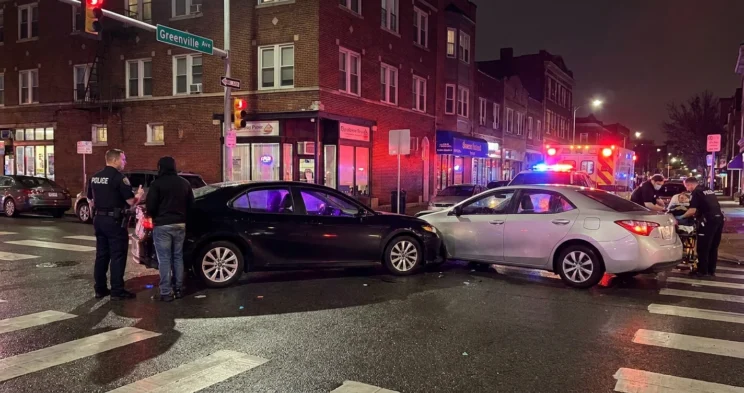
You were riding home from a friend’s place near Westover Hills when your Lyft driver ran a yellow light on Camp Bowie Boulevard and clipped a sedan turning left. Now you’re in an emergency room, and Lyft’s insurer is already telling you the driver is an independent contractor and the company isn’t responsible. The answer to whether you can actually sue Lyft is more layered than that phone call suggested.
Lyft’s Independent Contractor Defense in Texas
Lyft classifies its drivers as independent contractors, not employees. That classification blocks the usual respondeat superior theory, which holds an employer responsible for an employee’s negligence on the job. Texas law backs this structure under Texas Occupations Code Chapter 2402, which governs transportation network companies and does not require Lyft to treat drivers as employees.
That framing is legally accurate as a starting point, but it doesn’t end your claim. Two separate theories can still pull Lyft into the case directly. And even when Lyft is not a named defendant, its mandatory insurance program may still pay your damages.
If you were hurt in a Lyft crash as a passenger or another road user, the strategy of your rideshare accident claim depends on which theory and which insurance period applies.
When Lyft Can Be Held Directly Liable
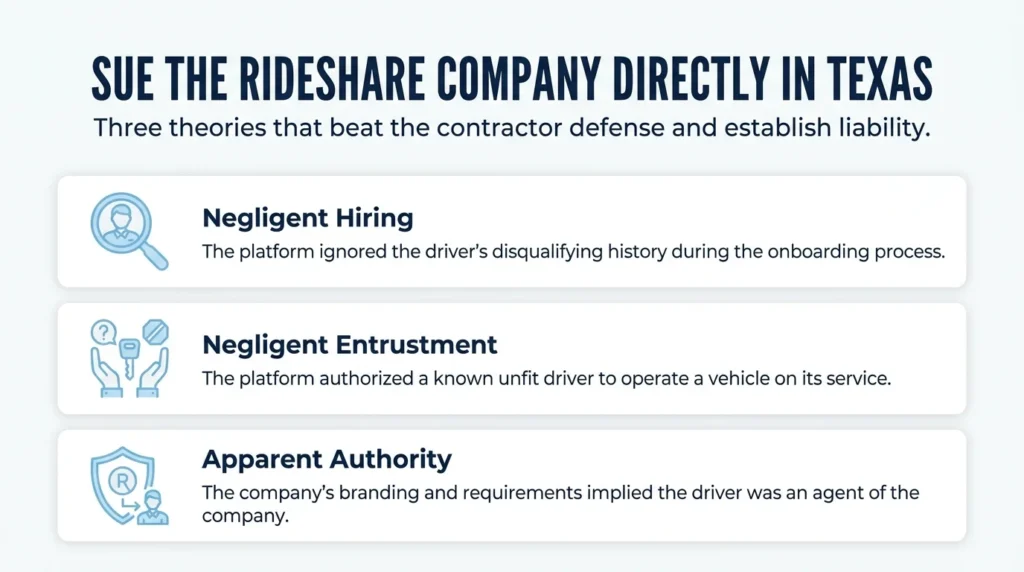
Two theories let you hold Lyft itself liable, not just the driver. The first is negligent hiring or retention. The second is negligent entrustment. A narrower apparent authority argument may also apply when Lyft’s branding led you to reasonably believe the driver was acting as Lyft’s agent.
Negligent Hiring or Retention
Lyft has a duty to screen, vet, and monitor the drivers it hires on its platform. If Lyft onboarded a driver with a known history of unsafe driving, prior DUIs, or disqualifying criminal conduct, a negligent hiring claim may survive the contractor defense.
The same is true if Lyft kept a driver active after complaints or red flags should have prompted removal.
Negligent Entrustment
Negligent entrustment works on a related theory. Lyft authorizes a specific person to carry passengers. If Lyft knew or should have known that the driver was unfit, the company may be on the hook regardless of the employment label.
These claims succeed or fail based on evidence, such as:
- Onboarding records
- Background check outputs
- Prior complaint logs
- The driver’s history
This material is in Lyft’s hands and can disappear quickly, making it harder to build a passenger injury claim after a car accident. An attorney can send preservation letters and pursue the records before they are routinely overwritten.
Lyft’s Tiered Insurance Coverage in Texas
Lyft’s insurance changes based on what the driver was doing when the crash happened. The average settlement range for a Texas Lyft accident often hinges on which of these periods was active at the moment of impact.

Texas Insurance Code Chapter 1954 sets the minimum coverage Lyft must carry during each app-status period. That statute, not the driver’s personal auto policy alone, controls how much insurance is actually available to pay your losses.
Period 1: App On, No Ride Accepted
When the driver’s Lyft app is on but they haven’t accepted a ride, coverage is limited. Lyft must carry contingent liability coverage of $50,000 per person, $100,000 per accident, and $25,000 for property damage. This coverage applies only if the driver’s personal auto policy does not cover the loss.
This is where you might hear, “You’re stuck with the driver’s personal policy.” Many personal auto policies exclude ride-for-hire activity, so the driver’s insurer may deny outright. When that happens, Lyft’s contingent coverage steps in.
Periods 2 & 3: Ride Matched Through Trip Completion
Once Lyft matches a driver with you (the passenger), and through the moment you exit the vehicle, Lyft’s $1 million liability policy is active. This is the period with the strongest coverage and the cleanest path to compensation through Lyft’s own program.
The $1 million policy is primary during Periods 2 and 3. It applies before any personal policy the driver has.
Lyft’s program has also historically included contingent comprehensive and collision coverage during these periods, though that benefit reflects Lyft’s own policy terms rather than a statutory mandate. The UM/UIM coverage that protects passengers and third parties when the at-fault driver lacks adequate insurance is required by Texas Insurance Code Chapter 1954.
Filing Deadlines for a Lyft Accident Claim in Texas
You generally have two years from the date of the crash to file a personal injury lawsuit. Texas Civil Practice and Remedies Code § 16.003 sets that deadline, and if you file a Lyft accident claim after two years, it will almost certainly be dismissed regardless of how strong the underlying facts are. If the injured person was a minor, different tolling rules may extend the deadline.
The clock runs from the crash date, not from the day you finish treatment or learn the full extent of your injuries. Waiting for medical care to wrap up before talking to an attorney is one of the most expensive mistakes you can make.
Lyft cases also involve evidence that fades fast. App data showing the driver’s status at the second of the crash, trip logs, background check records, and dashcam or traffic camera footage all have short retention windows. An attorney handling rideshare claims can move quickly to preserve the records that determine which insurance period was active, and reviewing typical outcomes in average Lyft accident settlements can help set realistic expectations.
Talk to a Texas Lyft Accident Attorney
A Lyft crash claim in Texas hinges on which insurance period was active, whether direct liability theories against the company apply, and how quickly evidence gets preserved. Those are not questions worth guessing at while an adjuster is on the phone.
Angel Reyes & Associates has more than 30 years of experience handling Texas personal injury cases and has secured more than $1 billion recovered for clients. We offer free consultations and work on contingency, meaning no fee unless we win. Schedule a free consultation to talk through your situation and your options.
Past results do not guarantee future outcomes.
Lyft Accident FAQs
Can Lyft deactivate a driver after an accident, and does that affect my claim?
Yes, Lyft can deactivate a driver at any time, including after a reported crash. Deactivation does not affect your right to pursue a claim against the driver or through Lyft’s insurance program for the incident that already occurred.
Does Lyft's insurance cover me if a Lyft driver hit my car and I was not a passenger?
Lyft’s liability coverage extends to third parties, not just passengers. If a Lyft driver caused a crash that injured you as another driver, cyclist, or pedestrian, the same tiered coverage rules apply based on the driver’s app status at the time of impact.
What happens to my claim if the Lyft driver was uninsured or had a lapsed personal policy?
Texas Insurance Code Chapter 1954 requires Lyft to carry uninsured and underinsured motorist coverage during active periods. If the driver’s personal policy was lapsed or excluded rideshare activity, Lyft’s contingent coverage can still respond depending on which app-status period was active.
Can I still recover damages if I was partially at fault for the crash in Texas?
Texas follows a modified comparative fault rule under Civil Practice and Remedies Code Chapter 33. You can still recover damages as long as your share of fault is 50% or less, though your recovery is reduced by your percentage of fault.
Does filing a claim with Lyft's insurer affect my right to file a lawsuit later?
Filing an insurance claim does not waive your right to sue. However, any settlement you accept from Lyft’s insurer will typically require you to release future claims, so you should understand the full value of your injuries before signing any release.
About the Authors

Angel Reyes
Writer
Angel L. Reyes, III is the Founder and Managing Partner of Angel Reyes & Associates. A nationally recognized trial attorney and business leader, Angel has helped over 70,000 injury victims recover more than $1 billion since founding the firm in 1993. Named to the Texas Super Lawyers list annually since 2008, Angel brings Wall Street experience, Ivy League education, and a deep commitment to client advocacy. He is a frequent legal commentator and published author with extensive contributions to legal scholarship, trial strategy, and consumer protection.

Kyle Nicolas
Editor
Kyle Nicolas is the Web Content & SEO Manager at Angel Reyes & Associates. He has more than 10 years of experience as a marketing co...

Angel Reyes
Reviewer
Angel L. Reyes, III is the Founder and Managing Partner of Angel Reyes & Associates. A nationally recognized trial attorney and business...