How to File a Bus Accident Claim in Texas


Every article on this site is researched by our internal team, reviewed for legal accuracy against current Texas law, and held to State Bar of Texas advertising standards before publication. We do not publish content that overstates outcomes or makes promises about results.
Learn more about our
editorial standards .
Key Takeaways
- Government bus claims require written notice within six months under the Texas Tort Claims Act
- Private bus company claims follow the standard two-year personal injury deadline in Texas.
- Government bus recoveries are capped at $250,000 per person and $500,000 per occurrence.

You were riding a METRO bus through downtown Houston when the driver braked hard and slammed into the car ahead. Now, you have a hospital bill, you missed your shift at work, and someone just left you a voicemail asking about your “claim.” You don’t know who actually pays for this, or how long you have to act.
However, learning how to file a bus accident claim doesn’t need to be complicated. How the process begins depends on who owned the bus.
Government Bus vs. Private Bus: Two Different Tracks
Texas bus accident claims follow one of two legal paths. If a government entity operated the bus, you face a strict notice deadline (as short as 45–90 days in some cities and six months under state law). If a private company operated the bus, you generally have two years. Picking the wrong track will cost you the case.

City buses like METRO in Houston, VIA in San Antonio, and DART in Dallas fall on the government track. So do school district buses and state agency vehicles. Private charter companies, tour operators, and for-hire commercial bus carriers fall on the private track.
Government buses are protected by sovereign immunity. This means they usually can’t be sued. The Texas Civil Practice and Remedies Code (CPRC) Chapter 101, known as the Texas Tort Claims Act, only allows lawsuits that meet specific conditions. Private companies don’t have this protection and are governed by standard personal injury and commercial carrier rules.
If you’re not sure which track applies, our overview of whether you can sue public transportation in Texas will walk you through how to identify the operator before you act.
Filing a Claim Against a Government Bus Operator
Government bus claims live or die by the notice deadline. You must deliver formal written notice to the correct governmental unit within months after the accident. The amount you can recover is also limited by law, even when your medical bills are higher than the limit. These two rules will shape every decision you make on this track.
The Six-Month Notice Requirement Under the Texas Tort Claims Act
Under CPRC § 101.101, written notice must reach the governmental unit within six months of the crash. The notice must describe the injury, the time and place of the incident, and the incident itself.

City charters can shorten that window. Houston requires notice within 90 days. Other Texas cities require as little as 45 days. The deadline depends on the specific entity that operated the bus.
Missing the deadline means you almost always lose the right to file the claim. Courts only make a rare “actual notice” exception if the governmental unit already had knowledge of the injury and that it may be responsible, and they apply this rule strictly.
Send your notice by certified mail to the correct office and keep proof of delivery. An attorney can confirm the right address and draft the notice before the window closes.
Damage Caps on Government Bus Claims
The Tort Claims Act limits your recovery under CPRC § 101.023, no matter how severe your injuries are. For claims against a municipality or the state (which covers city bus systems like METRO, DART, and VIA) the cap is $250,000 per person and $500,000 per occurrence for bodily injury or death. Claims against other governmental units (such as school districts or county entities) are subject to lower caps of $100,000 per person and $300,000 per occurrence.
The cap is fixed, so identifying every other liable party is critical. A negligent driver of another vehicle or a defective parts manufacturer may carry separate insurance outside of the cap. Our bus accident practice page explains how attorneys identify every potentially liable party in this kind of claim.
Filing a Claim Against a Private Bus Company
Private charter, tour, and for-hire commercial bus operators do not have sovereign immunity. In this case, standard Texas personal injury law applies, the deadline is two years, and the damage caps in § 101.023 do not apply. That means you may recover full compensatory damages, and, in some cases, extra damages (called “exemplary damages”) meant to punish negligent or reckless behavior.
The two-year deadline comes from Texas Civil Practice and Remedies Code (CPRC) § 16.003. If you file after two years, your case will be rejected.
Federal rules add another layer of complication. The FMCSA’s passenger carrier regulations require minimum insurance, safety inspections, and driver qualifications for commercial bus operators. A documented FMCSA violation can serve as evidence of negligence in your claim.
Liable parties in a private bus case can include the bus company itself for negligent hiring, training, or maintenance, the bus driver for direct negligence, a parts manufacturer for a product defect, or another driver who caused the crash. Sorting out who pays is rarely simple, which is why many riders consult legal counsel early. Our breakdown of whether you can sue a bus driver in Texas covers the driver-versus-company question in more detail.
Steps to Take After a Bus Accident in Texas
The same first steps apply on both tracks, but the urgency is higher when a government entity is involved. Get medical care, document everything, request the crash report, and protect your statements. The earlier you do these things, the stronger your claim will be.
Get medical attention right away, even if your injuries feel minor. A documented medical record will link the crash to your injuries, which is foundational in any claim.
Request a copy of your Texas crash report from TxDOT once it’s available. This report is primary evidence on both tracks.
Preserve every piece of evidence. Take photos of the scene, the bus number, and the driver’s information. Get witness contact details. Ask about surveillance video footage on the bus or at nearby buildings before it can be deleted.
Do not give a recorded statement to any insurance adjuster, city claims office, or bus company representative without legal guidance. Recorded statements taken in the first days after the accident are routinely used to reduce or deny claims.
Track every cost from day one, including medical bills, prescriptions, lost wages, and out-of-pocket expenses tied to the injury. To understand how these losses translate into compensation, our guide to the average settlement in a bus accident case is a useful reference.
If your child was hurt on a school bus, the school district is a governmental unit. The same six-month notice rule applies, and some districts have shorter charter deadlines that require claims to be filed sooner than usual.
What Compensation Can You Recover in a Bus Accident Claim?
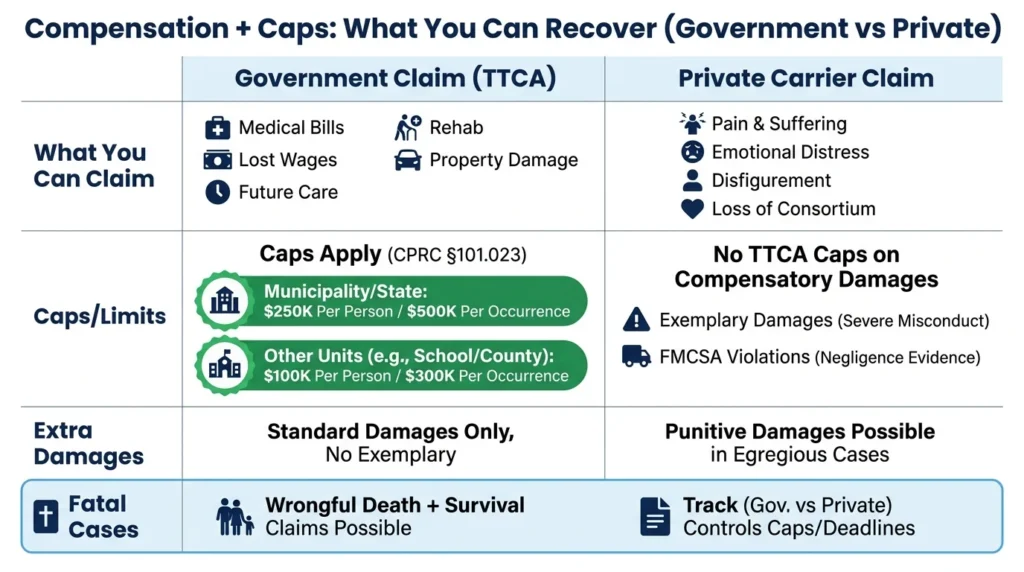
Claimants injured in bus accidents can recover money for economic damages (such as medical bills and lost wages) and non-economic damages (such as pain and suffering), but the maximum amount allowable depends on the track:
- Government claims are capped at $250,000 per person for municipal defendants.
- Private carrier claims have no legal limit on damages, and extra damages (called “exemplary damages”) may be available if the driver’s conduct was reckless or negligent.
- Fatal cases follow a different set of rules altogether.
Economic damages cover past and future medical expenses, lost wages, reduced earning capacity, rehabilitation, and property damage. Non-economic damages cover pain and suffering, emotional distress, disfigurement, and loss of consortium (such as loss or detrimental changes to a marital or family relationship due to the accident).
For fatal bus crashes, surviving family members can file a wrongful death claim or a survival claim. The filing deadline and maximum amount of money that can be recovered still depends on whether the bus was run by the government or a private company.
Our firm’s bus accident case results show how these damage categories affect real Texas claims.
Work with an Attorney for Your Claim
Angel Reyes & Associates handles both government and private bus accident claims across Texas. We have over 30 years of experience and have recovered more than $1 billion for clients.
Our team knows how to file the six-month notice on time, identify every liable party, and push back when an insurer or city claims office offers less than your case is worth. We work on contingency, which means you pay no fee unless we win, and we offer free consultations in English and Spanish. Read our client reviews and testimonials, then contact us today before the notice window closes.
Past results do not guarantee future outcomes.
Bus Accident Claim FAQs
What happens if a government bus driver was clearly at fault, but the city denies my claim notice?
A denial of your notice does not end your case. You can still file a lawsuit, but you must do so within the two-year statute of limitations and after the governmental unit has had a reasonable opportunity to respond to your notice.
Can a passenger injured on a private charter bus file a claim against both the charter company and the driver personally?
Yes. In Texas, the driver and the employer can be sued separately in the same lawsuit. The company may also be liable under a legal theory called “respondeat superior,” which holds employers responsible for employee negligence on the job.
Does Texas workers' compensation affect a bus accident claim if I was injured while commuting to work?
Generally, no. Texas workers’ compensation does not cover injuries sustained during a regular commute because those trips are not considered part of your employment duties. You would pursue a standard personal injury claim, rather than a workers’ comp claim.
Are charter buses that cross state lines covered by Texas law or federal law?
Both can apply at the same time. Texas personal injury law typically governs the claim itself, while federal FMCSA regulations set the safety and insurance standards that the carrier must meet. A violation of these federal rules can be used as evidence in your claim.
Can the bus manufacturer be held liable if a mechanical defect caused the crash?
Yes. If a defective part (such as a faulty brake system or steering component) contributed to the crash, the manufacturer or parts supplier can face a separate product liability claim. This claim is different from any negligence claim against the bus operator or driver.
About the Authors

Alex Ivanov
Writer
Alex Ivanov is a personal injury attorney at Angel Reyes & Associates, focused on car, truck, and motorcycle accident cases. Licensed in Texas and multiple federal districts, Alex brings international legal experience and a global education to his practice. He earned his LL.M. from Texas A&M University School of Law after graduating from Belarussian State University in 2016. Alex is fluent in Russian, English, Ukrainian, and Belarussian, and is recognized by multiple national trial lawyer associations for his results and leadership under 40.

Kyle Nicolas
Editor
Kyle Nicolas is the Web Content & SEO Manager at Angel Reyes & Associates. He has more than 10 years of experience as a marketing co...

Angel Reyes
Reviewer
Angel L. Reyes, III is the Founder and Managing Partner of Angel Reyes & Associates. A nationally recognized trial attorney and business...