How to Outsmart an Insurance Adjuster


Every article on this site is researched by our internal team, reviewed for legal accuracy against current Texas law, and held to State Bar of Texas advertising standards before publication. We do not publish content that overstates outcomes or makes promises about results.
Learn more about our
editorial standards .
Key Takeaways
- Insurance adjusters are trained to minimize payouts, not help you, so approach every interaction with appropriate caution.
- Avoid common mistakes like accepting quick settlement offers, giving recorded statements without preparation, and posting on social media during your claim.
- Texas law gives you two years to file a personal injury lawsuit, so do not let artificial deadline pressure push you into a decision you are not ready to make.

You were rear-ended in rush hour traffic on I-35 yesterday. Now the insurance adjuster is calling, asking questions, and pushing for a quick resolution. They sound helpful. They may even seem sympathetic. But their job is not to help you.
Insurance adjusters work for insurance companies. Their goal is to resolve your claim for the lowest possible payout. Understanding how they operate gives you the knowledge to protect yourself.
What Motivates Insurance Adjusters?
Insurance adjusters are trained professionals. Their performance is measured by how much money they save their company, not by how satisfied claimants are with their settlements.
This creates a fundamental conflict: the adjuster on the phone may sound helpful and concerned about your situation, but every question they ask gathers information that could reduce what the company pays you.
Texas insurance companies use specific strategies to minimize claim values. Adjusters receive training on how to identify weaknesses in claims, how to phrase questions that elicit damaging responses, and how to apply pressure at strategic moments.
None of this makes adjusters bad people; they are doing their jobs. But recognizing this dynamic helps you approach every interaction with appropriate caution.
Common Strategies Adjusters Use to Minimize Payouts
Adjusters have a toolkit of tactics designed to reduce what you receive. Knowing these strategies helps you recognize them when they happen.
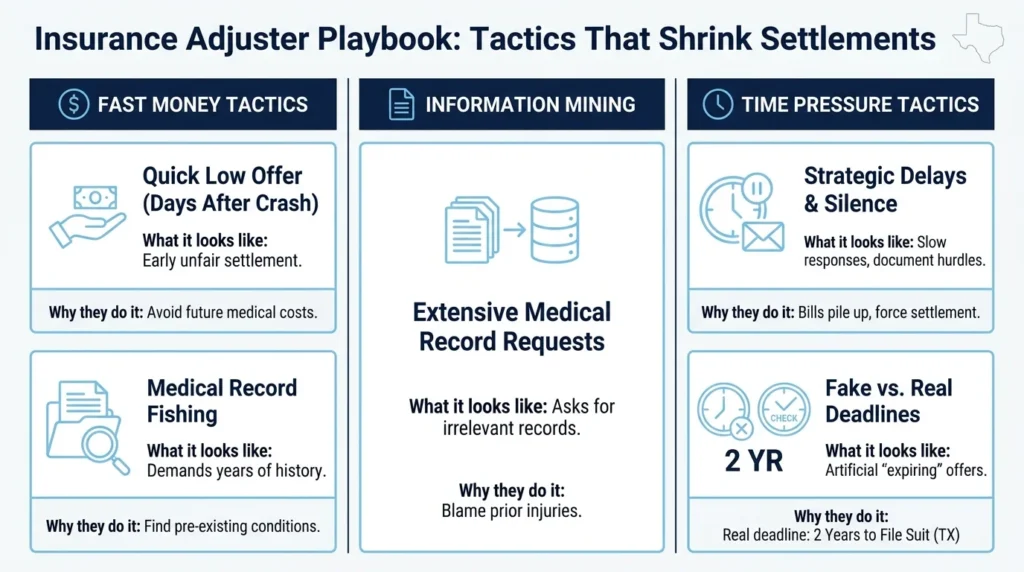
Quick settlement offers often come before you understand your full damages. An adjuster may call within days of your accident with an offer that sounds reasonable. The problem is that you may not yet know the full extent of your injuries or how long your recovery will take.
Requesting unnecessary medical records allows adjusters to search for pre-existing conditions. They may ask for years of medical history, looking for anything they can use to argue your injuries existed before the accident.
Adjusters also sometimes use delay tactics. The longer your claim drags on, the more financial pressure you face. Adjusters know that mounting bills and lost wages make claimants more likely to accept lower offers just to resolve the situation.
Common Mistakes Adjusters Hope You’ll Make
Adjusters count on claimants making certain errors to make their ultimate goal of saving their employer money easier. However, a prepared claimant can avoid making some of these mistakes, meaning they are able to better protect their case.
Accepting the first offer is one of the most common mistakes. Initial offers are almost always lower than what the claim is worth. Adjusters expect negotiation, so when you accept immediately, you leave money on the table.
Providing recorded statements without preparation gives adjusters ammunition. You are not required to give a recorded statement to the other driver’s insurance company in Texas. If you choose to give one, having an attorney present protects you from tricky or misleading questions.
Posting on social media during your claim can devastate your case. Even innocent posts can be taken out of context. The safest approach is to avoid posting anything about your accident, injuries, or daily activities until your claim is resolved.
Failing to document expenses means you cannot prove your losses. Keep receipts for everything: medical bills, prescriptions, transportation to appointments, and any other costs related to your accident.
Missing medical appointments creates gaps in your treatment record. Adjusters use these gaps to argue that your injuries were not serious enough to require consistent care. Follow your doctor’s recommendations and attend all scheduled appointments.
Finally, signing overly broad medical releases gives adjusters access to your entire medical history. You can limit releases to records relevant to your accident injuries. Read every document carefully before signing.
Common Adjuster Traps & How to Avoid Them
Beyond general tactics, adjusters set specific traps that catch unprepared claimants.
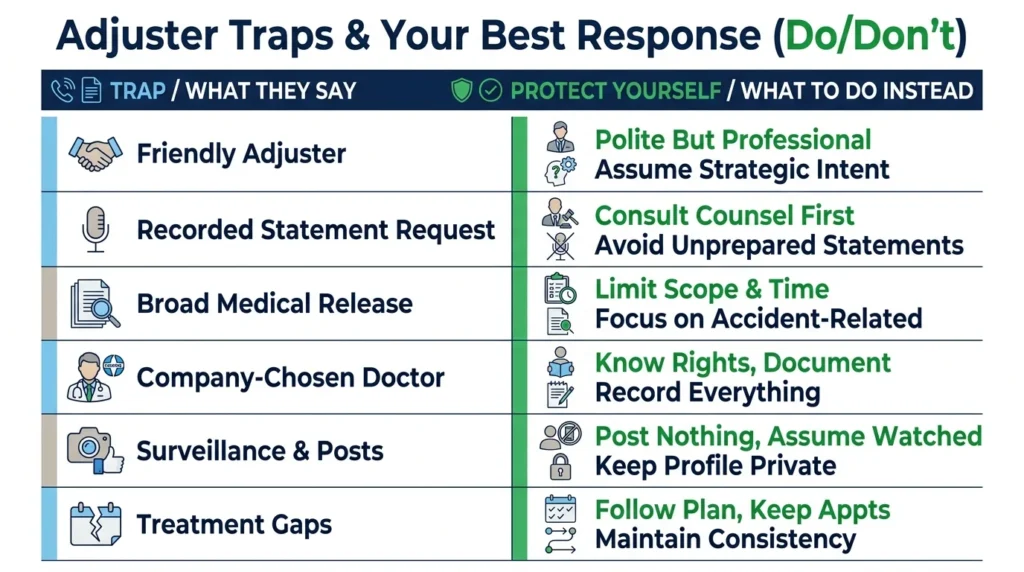
The “friendly adjuster” trap works because people naturally want to trust someone who seems kind. Maintain professional boundaries in every interaction. Be polite but remember: the adjuster is not your advocate.
Medical record fishing expeditions happen when adjusters request broad authorizations. You can and should limit any medical release to records directly related to your accident injuries and a reasonable time period.
Adjusters also use both real and made-up deadlines to pressure claimants into accepting a low settlement. An adjuster may claim their settlement offer expires soon, or that you must decide immediately. In most cases, these deadlines are artificial.
However, there is one very real deadline that adjusters know and may try to use to their advantage. Texas law gives you two years from the date of your accident to file a personal injury lawsuit under Texas Civil Practice and Remedies Code § 16.003. You have time to make informed decisions, but adjusters may try to drag out any claims that are filed late into this period in hopes of “waiting out” a claimant’s leverage for filing a lawsuit.
The Recorded Statement Trap
Requests for recorded statements deserve special attention because they are so common and so risky.
You have the right to decline a recorded statement to the at-fault driver’s insurance company, though you may be required to give a statement to your own company, depending on the language in your policy. If you do agree, you can request questions in advance, take breaks, and have an attorney present.
Adjusters review these statements carefully for a number of things, including:
- Admissions of any fault on your part
- Inconsistencies with the police report or medical records
- Statements minimizing your injuries
- Details that can be used to dispute your claim later
Independent medical examinations (IMEs) are another trap. The insurance company may request that you see a doctor of their choosing. These doctors are paid by the insurance company and often minimize injuries. You may have the right to refuse or to have your own doctor present.
Surveillance extends beyond social media. Adjusters sometimes hire investigators to follow claimants and record their activities. If you claim you cannot lift heavy objects, being filmed carrying groceries could damage your credibility.
Understanding the key points of the injury claim process helps you anticipate what comes next and prepare accordingly.
Essential Research Before Dealing with Adjusters
Preparation protects you. Before engaging with any adjuster, gather your information and understand your position.
First, understand your insurance policy. Know your coverage limits, deductibles, and what your policy requires of you. This knowledge prevents adjusters from making claims about your coverage that are not accurate.
Document everything immediately. Take photos of the accident scene, vehicle damage, and your injuries. Get contact information from witnesses. Request a copy of the police report.
Research the insurance company. Some companies have reputations for aggressive tactics or lowball offers. Online reviews and complaint records with the Texas Department of Insurance can reveal patterns.
Gather complete medical documentation. Get copies of all medical records, bills, and treatment plans related to your injuries. Expert opinions from your doctors about your prognosis strengthen your position.
Calculate your actual damages. Your losses extend beyond initial medical bills. Consider future medical care, lost wages, reduced earning capacity, and pain and suffering. Understanding the full value of your claim prevents you from accepting an offer that falls short.
When to Contact a Texas Personal Injury Attorney
Certain situations signal that you need professional help to protect your claim. If you’re seeing signs of unfair tactics, such as unreasonable delays, lowball offers that ignore documented damages, requests for excessive medical records, or pressure to settle before you have completed treatment, reach out to a legal professional for help.
Attorneys level the playing field. Insurance companies have teams of professionals working to minimize your claim. An experienced personal injury attorney understands their tactics and knows how to counter them.
Texas insurance law provides protections for claimants. An attorney can identify when an insurance company violates these regulations and hold them accountable.
Outcomes differ significantly between represented and unrepresented claimants. Studies consistently show that claimants with attorneys receive higher settlements, even after attorney fees.
At Angel Reyes & Associates, we have spent over 30 years helping Texans recover more than $1 billion by successfully navigating insurance claims. We offer free consultations and work on contingency, meaning you pay nothing unless we recover compensation for you.
If an insurance adjuster is pressuring you or you suspect unfair tactics, contact us to discuss your situation. We are available 24/7 and serve clients throughout Texas.
Adjuster Tactics FAQs
Can you sue an insurance company in Texas for acting in bad faith?
Yes. Texas Insurance Code Chapter 541 allows lawsuits against insurers that misrepresent coverage, refuse reasonable investigations, or use unfair settlement practices. A successful claim can result in up to three times your actual damages.
Is dealing with your own insurance company different from the other driver's?
Yes. Your policy likely requires cooperation with your own insurer, including recorded statements, but you have no such obligation to the at-fault driver’s company. However, your own insurer must still handle your claim in good faith.
What happens after you reject a settlement offer?
Rejecting an offer does not end your claim. The adjuster typically responds with a revised offer or requests additional documentation. Several rounds of negotiation are normal, and filing a lawsuit often restarts stalled discussions.
What if the adjuster says you were partially at fault?
Texas allows recovery as long as you are not more than 50% at fault, but your award is reduced by your share of blame under § 33.001. Do not agree to any fault determination from an adjuster without legal guidance.
Will you receive the full amount of your settlement?
Not necessarily. Healthcare providers, insurers, and government programs like Medicaid may hold liens against your settlement under Texas Property Code Chapter 55. An attorney can often negotiate these liens down to increase your take-home amount.
About the Authors

Angel Reyes
Writer
Angel L. Reyes, III is the Founder and Managing Partner of Angel Reyes & Associates. A nationally recognized trial attorney and business leader, Angel has helped over 55,000 injury victims recover more than $1 billion since founding the firm in 1993. Named to the Texas Super Lawyers list annually since 2008, Angel brings Wall Street experience, Ivy League education, and a deep commitment to client advocacy. He is a frequent legal commentator and published author with extensive contributions to legal scholarship, trial strategy, and consumer protection.

Kyle Nicolas
Editor
Kyle Nicolas is the Web Content & SEO Manager at Angel Reyes & Associates. He has more than 10 years of experience as a marketing co...

Angel Reyes
Reviewer
Angel L. Reyes, III is the Founder and Managing Partner of Angel Reyes & Associates. A nationally recognized trial attorney and business...