Freight Broker vs. Motor Carrier in Texas Truck Accidents


Every article on this site is researched by our internal team, reviewed for legal accuracy against current Texas law, and held to State Bar of Texas advertising standards before publication. We do not publish content that overstates outcomes or makes promises about results.
Learn more about our
editorial standards .
Key Takeaways
- Freight brokers arrange transportation. Motor carriers provide transportation. This distinction affects liability and available defense strategies in Texas truck accident cases.
- Texas proportionate responsibility rules allocate fault among multiple parties. If you are found 51% or more responsible, you are prohibited from recovering anything.
- FAAAA preemption can block certain claims against negligent brokers, which makes it critical to highlight multiple areas of negligence across the shipment chain.
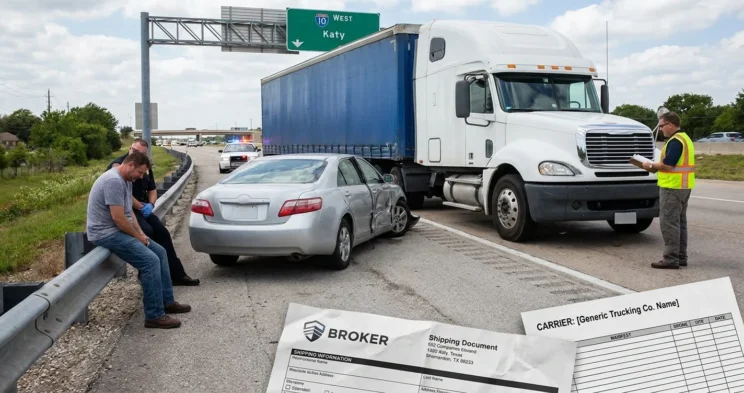
You were driving home on I-10 near Katy when an 18-wheeler changed lanes without warning and sideswiped your car. Now, you’re dealing with injuries, vehicle damage, and a confusing web of companies, including the driver, a trucking company, a freight broker, and a shipper, and they’re all blaming each other.
Understanding who was responsible can determine whether you get fair compensation for your truck accident or get caught in the blame game.
Why the Difference Between a Broker & a Carrier Is Important
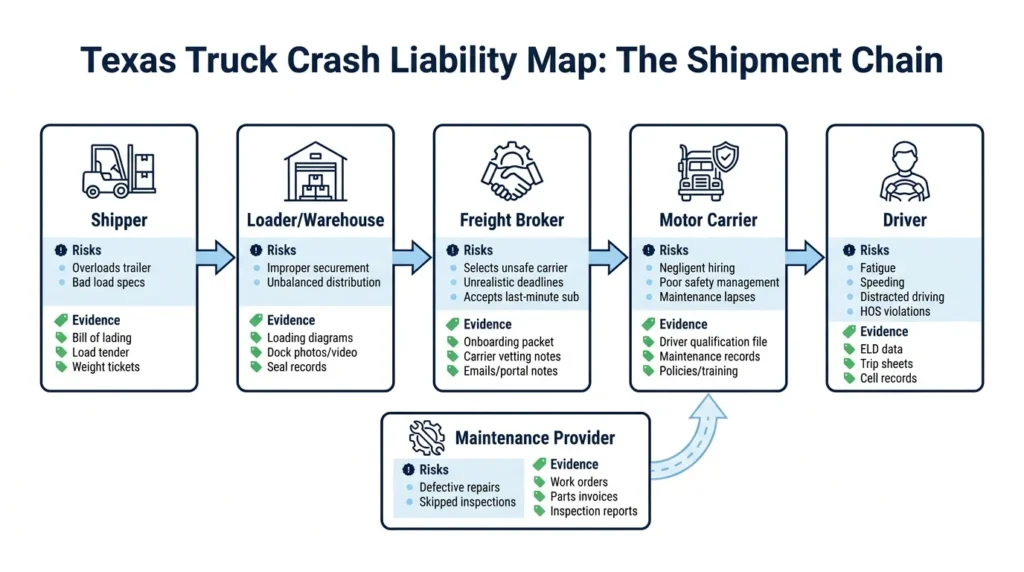
Many people assume the trucking company is the only target after a crash. The reality is more complicated than that, as a single shipment can involve a driver, motor carrier, shipper, loader, freight broker, and maintenance provider. Texas law allows fault to be distributed across multiple parties, which means identifying every responsible party early in the process can directly affect your recovery.
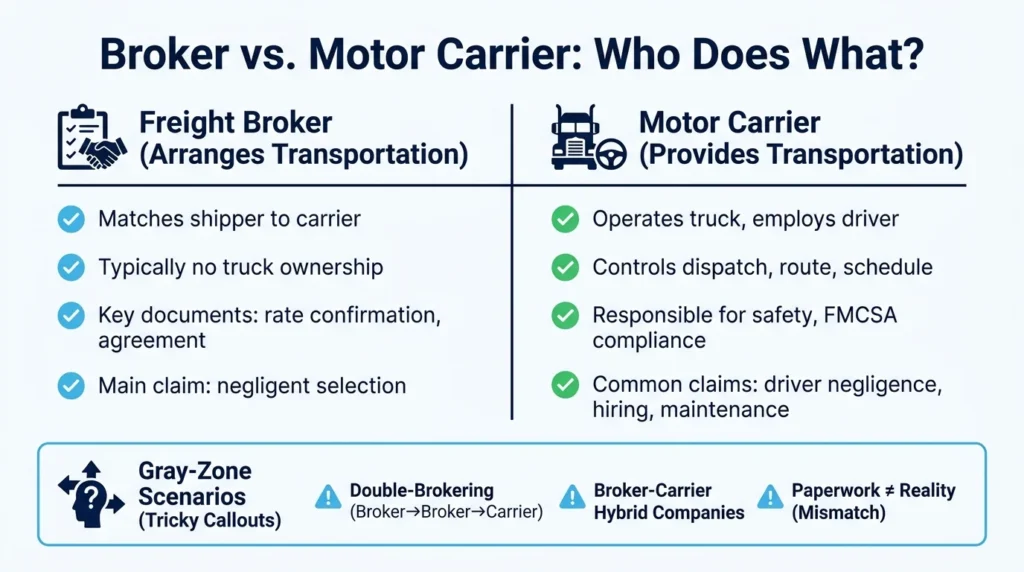
The distinction between a broker and a carrier can be the issue that changes what your case looks like. Brokers often argue they didn’t provide transportation; they only arranged it, and this argument affects their responsibilities and whether federal law protects them from certain claims. Correctly identifying their role can shape the entire case.
The Difference Between a Freight Broker & Motor Carrier Explained
Under 49 U.S. Code § 13102, a broker is a person who arranges shipments of property by motor carrier for payment. A motor carrier is the company responsible for actually transporting the goods using vehicles and drivers.
Think of it this way: the broker is the matchmaker, and the carrier is the one driving the truck.
A motor carrier typically employs or has a contract with the driver, owns or leases the tractor and trailer, and decides the driver’s route. The carrier is directly responsible for ensuring driver qualifications, vehicle maintenance, and compliance with federal safety regulations.
However, this is not always straightforward. For example:
- Double-brokering occurs when one broker gives a shipment to another broker, instead of giving it directly to a carrier.
- Some companies operate as both broker and carrier, depending on the shipment.
- Paperwork doesn’t always match reality. A rate confirmation might list one company, while the actual driver works for a totally different one.
Federal Regulations in Broker vs Carrier Dispute
49 C.F.R. § 371.2 defines key terms that are often argued about during lawsuits. A brokerage service means the service that arranges transportation or the physical movement of a motor vehicle. A bona fide agent is someone who acts on behalf of a carrier or shipper, rather than working as an independent broker.
Courts look at specific factors to determine whether a company was arranging or providing transportation. Some of these factors are:
- Who selected the carrier?
- Who dispatched the driver?
- Who controlled the route and schedule?
- Who paid whom?
These factors often determine what responsibilities apply and what legal defenses can be used.
Who is Responsible in the Shipment Chain?
A truck crash can happen because of multiple failures in the shipping process. For example:
- The driver may have been fatigued.
- The carrier may have hired someone with a dangerous driving history.
- The shipper may have overloaded the trailer.
- The broker may have selected a carrier with known safety violations.
Each part of the process creates potential liability.
Cases involving multiple parties depend on documentation. For example:
- ELD (electronic logging device) data shows how many hours the driver was on the road.
- Driver qualification files reveal hiring decisions.
- Maintenance records expose mechanical neglect.
- Contracts between brokers and carriers outline responsibilities.
Knowing what to request after a truck accident can help you preserve critical evidence before it disappears.
Driver & Motor Carrier Liability Explained
Driver negligence remains the most common cause of truck accidents in Texas. Speeding, distracted driving, driving under the influence, following distance, and violating hours-of-service limits can all create liability. Electronic Logging Device (ELD) data can show whether a driver exceeded legal driving limits before the crash.
Motor carriers can be held responsible in several ways. Under a rule called respondeat superior, a carrier is liable for driver negligence during working hours.
Negligent hiring claims focus on whether the carrier knowingly hired a reckless driver. Texas courts generally require plaintiffs to show that the employer knew or should have known that their employee posed a risk. For example, a carrier that hires a driver with multiple prior crashes or DUI convictions may be directly responsible for their hiring decision.
Negligent maintenance claims focus on whether the company failed to properly inspect and repair its vehicles.
Who is Liable for Improperly Loaded or Secured Cargo?
Improperly loaded or secured cargo can cause crashes or make them worse:
- Shifting cargo affects vehicle stability, braking, and steering.
- An overloaded trailer takes longer to stop.
- Unbalanced weight distribution increases the chance of a rollover accident.
The FMCSA cargo securement rules establish minimum requirements for securing different types of freight. Violations of these rules can support negligence claims.
Liability depends on who actually loaded and secured the cargo. “Shipper load and count” notations on bills of lading indicate that the shipper handled the loading process, but if the carrier loads the cargo, they are primarily responsible for securing it. Contracts and communications between these two parties often clarify which party was responsible for loading and securing the cargo.
When Can a Freight Broker Be Liable in a Texas Truck Accident Case?
The main claim against brokers is negligent selection, meaning that the broker chose an unsafe carrier even though reasonable vetting could have laid out the risks beforehand. What is meant by “reasonable vetting” varies, but it generally includes checking the company’s operating authority, insurance status, and safety record.
Other claims involve coordination issues. For example, a broker that imposes unrealistic delivery deadlines may pressure their drivers to violate hours-of-service rules. Alternatively, a broker that accepts a last-minute carrier substitution without checking its credentials may share responsibility if the substitute carrier causes an accident.
Finally, the distinction between “influence” and “control” is important. Brokers that go beyond simply arranging transportation and start getting involved in managing operations (such as dictating routes, requiring specific drivers, or controlling load sequences) may be told that, since they assumed carrier-like duties, they will be treated like a carrier and will face more liability.
How to Prove Broker Liability
Broker-carrier agreements often contain indemnification clauses (rules about who is responsible if something goes wrong), safety requirements, and carrier qualification statements. Rate confirmations show what the broker knew about the shipment. Onboarding packets show how carefully the broker vetted the carrier before hiring them.
Communication is equally important. Emails and texts about deadlines, route constraints, or driver changes can show whether the broker created unsafe pressure. Portal notes and dispatch records may reveal what the broker knew and when they found out about it.
The broker’s prior knowledge is often the deciding factor. If the broker previously received complaints about the carrier, knew about insurance lapses, or had access to safety data that showed violations, that knowledge makes it easier to prove they chose an unsafe carrier, which can strengthen your claim.
FAAAA Preemption & Safety Exception Explained
Brokers frequently argue that the Federal Aviation Administration Authorization Act (FAAAA) prevents state negligence claims. The FAAAA prohibits states from enacting or enforcing laws “related to a price, route, or service” of any motor carrier, broker, or freight forwarder who transports property.
A “safety exception” exists for claims related to motor vehicle safety. FAAAA preemption still allows negligent hiring or selection claims to be filed against brokers in Texas, and on May 14, 2026, the U.S. Supreme Court unanimously ruled in Montgomery v. Caribe Transport II, LLC that these claims fall within the FAAAA’s safety exception. This means that brokers can no longer automatically dismiss these cases and must now defend themselves in court.
This affects their legal strategy. Plaintiffs often need to prove that multiple parties (such as the carrier, driver, shipper, and loader) were at fault, so the case doesn’t depend entirely on broker liability. This helps protect the case against preemption dismissals.
How to Build a Case Against Multiple Liable Parties
It’s important to identify every party that could share liability for the crash early on. Carrier safety failures, driver negligence, loader negligence, and maintenance defects are all possible avenues to pursue recovery. Broker claims can supplement these avenues, rather than being the only way to recover compensation.
Preserve evidence from all parties immediately. Spoliation letters sent to carriers, brokers, and shippers can prevent the destruction of ELD data, contracts, and communications. You need to act fast because some electronic data may be deleted shortly after the accident.
Due to Texas proportionate responsibility rules, it’s critical to identify all parties right away. If a responsible party isn’t named, the defense may attempt to shift fault to them and reduce the amount of money you can recover.
The Texas 51% Rule: What is Proportionate Responsibility?
Under Texas Civil Practice and Remedies Code Chapter 33, fault is allocated among all responsible parties. If you are found 51% or more responsible for your own injuries, you recover nothing. If you are 50% or less responsible, your damages are reduced by your percentage of fault.

In cases with multiple defendants, juries assign percentages to each party. A verdict might allocate 60% to the driver, 25% to the carrier, 10% to the broker, and 5% to the shipper. Each defendant only pays their share.
For example, let’s say you suffer $500,000 in damages. The jury finds the driver 50% at fault, the carrier 30% at fault, and you 20% at fault, which means your recovery is reduced by 20%, leaving you with $400,000. The driver must pay you $250,000. The carrier must pay you $150,000.
How to Build a Strong Claim in a Texas Accident Case
First, identify every potentially responsible party before filing your claim. Late additions may be harder to incorporate into your case and will give the defendants a chance to argue that the party missing from the case is the sole party at fault.
Next, gather evidence that ties each party to a specific mistake. General involvement in the shipment isn’t enough; you will need to prove that a particular party failed to follow a particular safety protocol, and this failure contributed to the crash.
Finally, expect the other parties to defend themselves, as defendants will try to say that you are at fault for speeding, distracted driving, or not using your seatbelt. They will also try to blame third parties, and brokers will try to argue that federal law protects them from your claim. Preparing for these challenges early will strengthen your case.
What to Do After a Texas Truck Crash Involving a Broker or Shipper
- Seek medical attention immediately. Your health comes first, and medical records will help document your injuries.
- Obtain the police report. It often identifies the driver, carrier, and sometimes the broker or shipper, and you should look for the MC and DOT numbers on the truck. These numbers can help identify the registered carrier.
- Request shipment documents right away. The bill of lading, rate confirmation, and broker-carrier agreement will identify the parties involved, as well as their responsibilities. This information may not be available later without a formal legal discovery process.
- Act quickly to preserve evidence. ELD data, dispatch communications, and portal records may be deleted shortly after the accident. Quickly sending a preservation letter can prevent spoliation (when important evidence is lost, destroyed, or altered if it is needed for a legal case).
How Angel Reyes & Associates Can Help
Truck accident cases involving multiple parties require thorough investigation and strategic planning. With over 30 years of experience and more than $1 billion recovered, our firm has the resources to identify every responsible party and build a case that considers Texas’s proportionate responsibility rules and federal preemption challenges.
We have a team of more than 600 dedicated professionals, including attorneys who are fluent in both English and Spanish. We offer free consultations and work on contingency, meaning you do not pay a fee unless we win; and serve the entire state of Texas across more than 20 offices statewide. We can handle the majority of your case remotely, so contact us today to discuss your options.
Past results do not guarantee future outcomes.
Broker vs. Carrier Liability FAQs
Can a company be both a freight broker and a motor carrier?
Yes. Some transportation companies operate in both roles, and liability may depend on which role they were actually performing for the load involved in the crash.
What does “shipper load and count” usually mean in a truck-accident case?
It generally means the shipper says it loaded the cargo and counted it, which can be a deciding factor when a case involves overloaded or improperly balanced freight. However, the phrase “shipper load and count” does not automatically decide liability, because the facts of the incident, whether anyone had the opportunity to inspect the cargo, and the terms of the contract are also deciding factors.
If the broker is dismissed from the case, can other parties still be held responsible?
Yes. A truck-accident claim may still proceed against the driver, motor carrier, shipper, loader, maintenance company, or other parties if the evidence suggests they are at fault.
Can federal safety records make a difference even if the crash happened in Texas?
Yes. Carrier authority status, insurance filings, and certain safety history records can help show whether warning signs existed before the load was assigned. These records are only part of the picture, but they can be important when investigating how the shipment was handled.
About the Authors

Alex Ivanov
Writer
Alex Ivanov is a personal injury attorney at Angel Reyes & Associates, focused on car, truck, and motorcycle accident cases. Licensed in Texas and multiple federal districts, Alex brings international legal experience and a global education to his practice. He earned his LL.M. from Texas A&M University School of Law after graduating from Belarussian State University in 2016. Alex is fluent in Russian, English, Ukrainian, and Belarussian, and is recognized by multiple national trial lawyer associations for his results and leadership under 40.

Kyle Nicolas
Editor
Kyle Nicolas is the Web Content & SEO Manager at Angel Reyes & Associates. He has more than 10 years of experience as a marketing co...

Angel Reyes
Reviewer
Angel L. Reyes, III is the Founder and Managing Partner of Angel Reyes & Associates. A nationally recognized trial attorney and business...