How Trucking Companies Deny Liability After a Texas Crash


Every article on this site is researched by our internal team, reviewed for legal accuracy against current Texas law, and held to State Bar of Texas advertising standards before publication. We do not publish content that overstates outcomes or makes promises about results.
Learn more about our
editorial standards .
Key Takeaways
- Carriers often claim comparative fault against the victim; Texas's modified fault rule bars recovery only above 50% fault, but partial fault still reduces the award.
- Scope of employment defenses are defeated by ELD data, GPS records, and dispatch records that establish the driver was operating under carrier authority.
- Rapid response teams give carriers an early evidence advantage; a preservation letter sent immediately after the crash begins to level that imbalance.
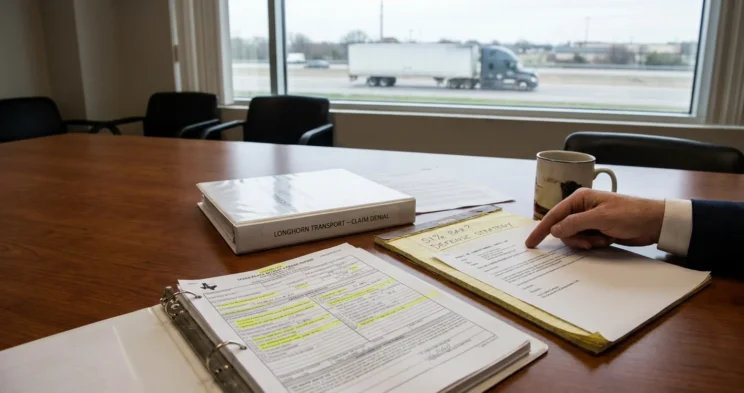
When a commercial truck causes a serious crash on I-35 near Dallas, the trucking company’s defense begins before most victims have left the emergency room. Understanding the specific arguments carriers use to dispute liability — and knowing what evidence defeats each one — is not optional preparation. It is the foundation of protecting your claim.
Why the Defense Starts Before You Do
Trucking companies and their insurers deploy rapid response teams to crash scenes within hours. These teams include investigators, defense attorneys, and adjusters whose job is to document the scene, take witness statements, and secure electronic data — all before the injured party has legal representation.
The goal is not to find the truth. It is to build a record that limits the carrier’s liability. Every piece of evidence they collect first is evidence they help shape. Every witness statement they take before you do is a statement their defense team has reviewed.
Blaming You — The Comparative Fault Defense
The most common liability denial tactic is claiming the victim caused or contributed to the crash. Texas uses a modified comparative fault system under Texas Civil Practice and Remedies Code Chapter 33.
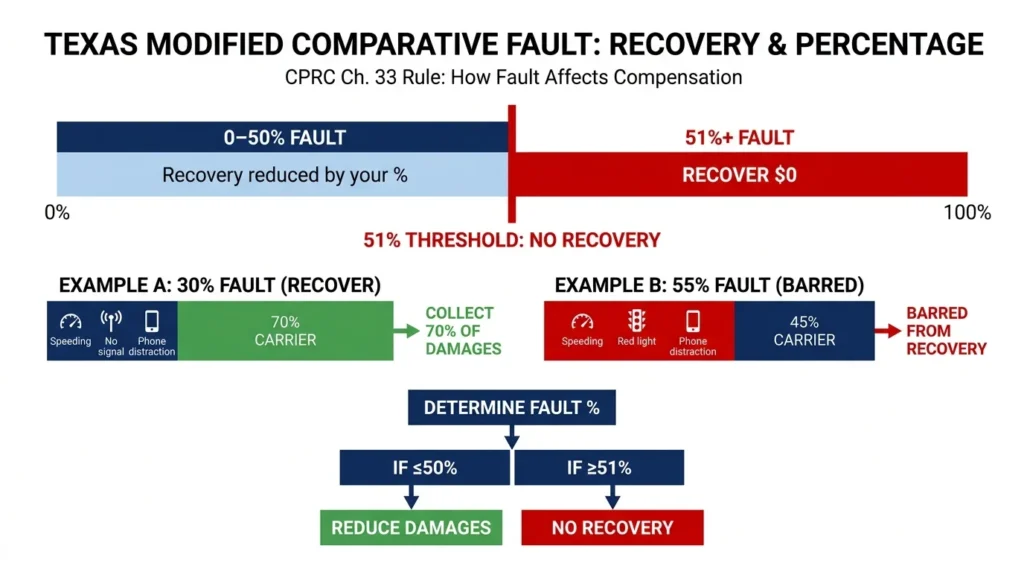
A victim who is more than 50% at fault recovers nothing. Below 50%, the recovery is reduced by the victim’s percentage of fault. For example, if the victim is found 30% at fault, they recover 70% of the damages claimed.
Carriers routinely allege that the victim changed lanes without signaling, was speeding, ran a red light, or was distracted by a phone. They do not need to prove these allegations definitively — they need only to plant enough doubt to persuade a jury to assign 30–40% fault to the victim to reduce how much they pay.
The evidence that defeats comparative fault arguments is concrete: traffic camera footage showing the actual sequence of events, independent witness statements, accident reconstruction analysis, and the truck’s own black box data showing the truck’s speed and braking pattern in the seconds before impact. The carrier’s black box records are most useful when obtained early, before they can be altered.
Claiming the Driver Was an Independent Contractor
When the carrier cannot deny that the crash happened, it often argues it is not responsible because the driver was an independent contractor, not an employee. Under Texas law, an employer is liable for the negligent acts of salaried employees during working hours — but not, in most cases, for the acts of independent contractors.

The carrier’s argument is that the contractual classification answers the question. Texas courts disagree. Courts look at the degree of control the carrier actually exercised over the driver’s work:
- Did the carrier control the routes?
- Set the schedules?
- Establish hiring and training standards?
- Provide the equipment?
The contract label is one factor, not the decisive one.
FMCSA regulations add a second layer of carrier responsibility. The authorized carrier assumes full responsibility for all operations conducted under its USDOT authority, regardless of whether the driver is classified as an employee or contractor. A carrier that dispatched the driver under its authority cannot use an IC label to walk away from federal obligations.
The evidence that defeats the IC defense: driver qualification files (which the carrier maintained as required by FMCSA), dispatch records showing the carrier controlled the load and route, and the carrier’s own FMCSA filings showing the driver operated under its authority.
Scope of Employment — Claiming the Driver Was Off Duty
Even when the carrier cannot deny the driver’s status as an employee or authorized operator, it may argue the driver was acting outside working hours at the time of the crash. This argument surfaces most often when the crash occurred at the beginning or end of a trip, during a meal stop, or when the driver had deviated from the authorized route.
Under Texas law, an employer is liable for an employee’s negligent acts only when they occur within working hours. A driver who left the authorized route for a personal errand may fall outside the employment scope, potentially relieving the carrier of related liability.
The evidence that defeats this defense is electronic. ELD data records every mile the truck traveled, providing a complete route history, while GPS data from the tractor shows the actual path. Dispatch records show what authorization existed and when it expired.
Since the carrier controls those records, a legal request known as a preservation demand must be sent immediately after the crash to obtain essential evidence.
Texas Transportation Code Section 550.021 requires the driver to stop, identify themselves, and provide aid after any crash. The driver’s obligation to comply with traffic law is a commercial obligation, and its context — the commercial vehicle, the load, the route — speaks to the nature of the operation even when the carrier tries to distance itself.
Evidence Control — How Carriers Shape the Narrative
The carrier’s most powerful advantage is not legal argument. It is timing. Rapid response teams arrive at the scene while the evidence is fresh. They photograph, interview, and document before defense-favorable facts can change.
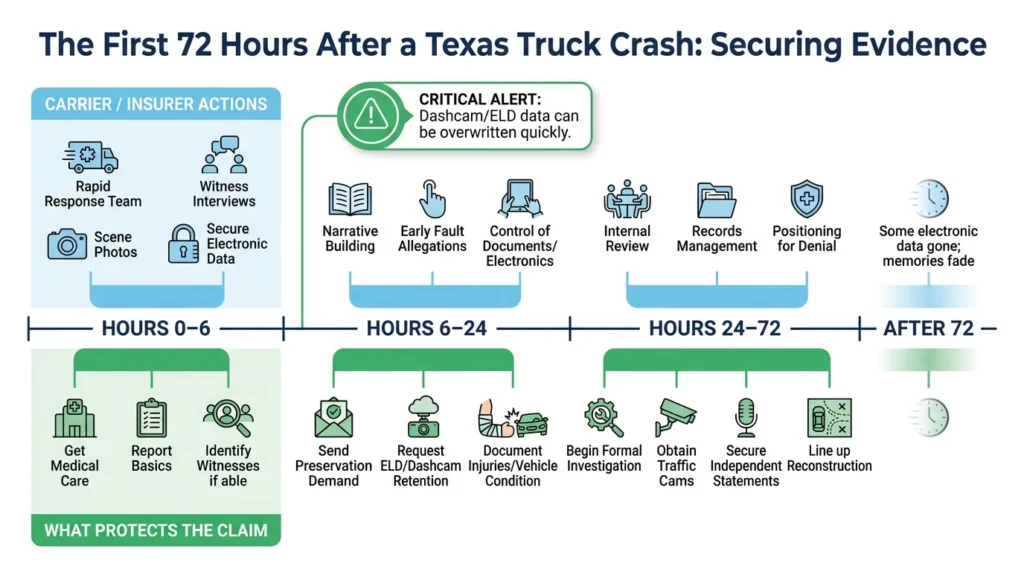
Electronic logging device data, such as dashcam footage, may be gone within days. Maintenance records that show the carrier knew about a brake defect may be buried in a filing system the victim cannot access without litigation. And in cases involving the most serious liability, some carriers dissolve and restructure their corporate entities — known as chameleon carriers — to complicate judgment collection after trial.
The counter is legal, not technological. An evidence preservation letter sent to the carrier post-crash obligates the company to retain all evidence relevant to the crash. It creates an obligation the carrier violates at its peril. FMCSA carrier history and DOT inspection records provide a parallel record even if the carrier attempts to restructure.
Talk to a Truck Accident Lawyer
When a trucking company disputes liability, their defense team has been working since the moment of the crash. They know which arguments to raise, which evidence to gather first, and how to use comparative fault allegations even when the crash is clearly the driver’s fault. Matching that preparation requires an attorney who has seen these defenses before.
Angel Reyes & Associates has handled truck accident cases across Texas for over 30 years. We offer free consultations with no fee unless your case is resolved in your favor. If the trucking company has disputed liability or is claiming you were at fault, contact us today or learn more about our truck accident practice.
Past results do not guarantee future outcomes.
Trucking Company Liability FAQs
What should I do if the trucking company’s insurer contacts me after a crash?
You can provide basic identifying information, but you do not have to give a recorded statement before understanding your injuries, the evidence, or how the statement may be used against you. This is especially important when the carrier is already disputing fault.
Can a truck’s maintenance history affect liability in a Texas crash case?
Yes. Maintenance records, inspection reports, and repair logs can show whether the carrier ignored brake, tire, lighting, or steering problems before the crash.
How long can electronic truck crash evidence be available?
Some electronic evidence may be overwritten or lost quickly unless it is preserved, so a prompt preservation demand can be important after a serious truck crash. Federal motor carrier rules also require certain records to be kept for defined periods, but those periods vary by record type.
Can more than one company be responsible for a commercial truck crash?
Yes. Depending on the facts, liability may involve the motor carrier, broker, shipper, maintenance provider, trailer owner, or another company that contributed to unsafe operations.
What happens if a Texas truck crash victim is partly at fault?
Under Texas Civil Practice and Remedies Code Section 33.001, a claimant cannot recover damages if their percentage of responsibility is greater than 50%. If their fault is 50% or less, any recovery is reduced by that percentage.
About the Authors

Alex Ivanov
Writer
Alex Ivanov is a personal injury attorney at Angel Reyes & Associates, focused on car, truck, and motorcycle accident cases. Licensed in Texas and multiple federal districts, Alex brings international legal experience and a global education to his practice. He earned his LL.M. from Texas A&M University School of Law after graduating from Belarussian State University in 2016. Alex is fluent in Russian, English, Ukrainian, and Belarussian, and is recognized by multiple national trial lawyer associations for his results and leadership under 40.

Kyle Nicolas
Editor
Kyle Nicolas is the Web Content & SEO Manager at Angel Reyes & Associates. He has more than 10 years of experience as a marketing co...

Angel Reyes
Reviewer
Angel L. Reyes, III is the Founder and Managing Partner of Angel Reyes & Associates. A nationally recognized trial attorney and business...